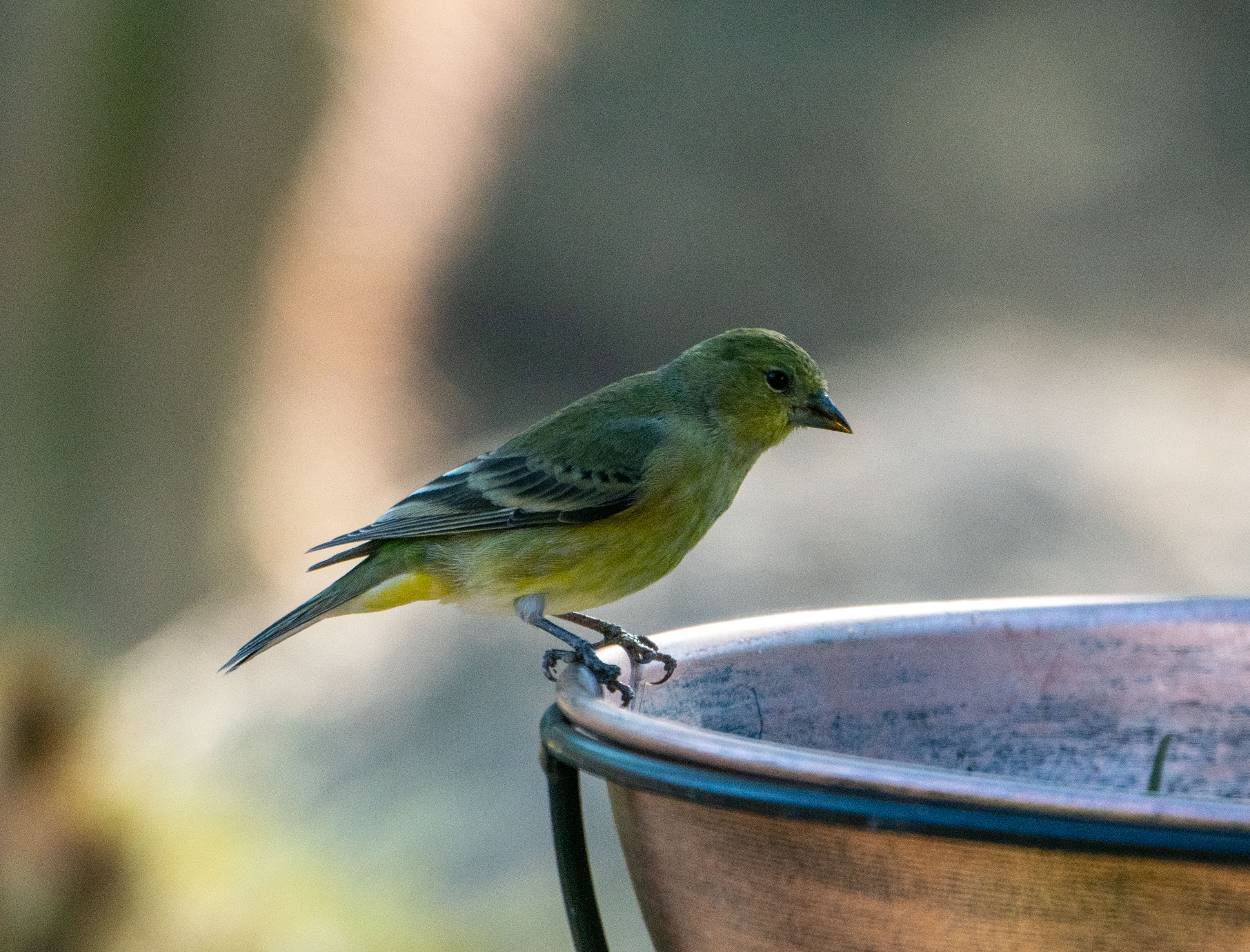
This is a fledgling who appeared with Red in my Wednesday post. This is such a fun year with a possible three babies to watch with Red and Mrs., my backyard cardinal couple.
Add to that multiple quail families with babies ranging from brand new and itty bitty to rangy teens.
Baby quail.
Papa guarding his babies.
A family of older babies hanging out in the shade under a bench with daddio. Smart birds! It’s gotten hot!
These are the itty bitty babies.
Then there’s the backyard bully bird — the Curve-Billed Thrasher. He doesn’t look so mean perched on a pink flamingo a friend gave me from Costco for a birthday present.
A female Gilded Flicker can make a quick dent in the food block.
Do you have a favorite photo? If so which one?
What’s on the agenda for the first weekend of June?
This is one of two Northern Cardinal fledglings that made an appearance in our yard this past week. He’s with his dad. Although the coloring of the fledgling looks like an adult female, fledglings beaks are gray or black while the adults’ beaks are bright orange.
The Latin name for the northern cardinal is Cardinalis cardinalis.
This is the smaller fledgling. They are gray until about three months when their coloring appears. Until then I won’t know if these are males or females. If they are male they will get splotches of red. If female, they’ll get the orange highlights of the female adult.
This is Mrs., our adult female cardinal and mom of the two fledglings.
We have had a cardinal male and female in our yard for two years. I’ve named them Red and Mrs. I’ve been waiting patiently to see if they’d have a family, and I’m beyond excited to see their fledglings.
The female lays three to four eggs and incubates them by herself for 12 to 13 days. The young leave the nest in about nine to 11 days after hatching. Once they leave the nest, they are called fledglings. Both parents feed their young but often it is the father.
Here’s Red feeding his large fledgling.
Fledglings will often hide in bushes or shrubs while most often the male will feed them for a few weeks. They become fully independent after about a month. I am curious if they will stay in our yard, or will find their own home away from their parents.
UPDATE:
A day after I wrote and scheduled this post, I saw Red with a brand new fledgling or possibly fledgling number 2 who I named “Mini me”. Here are a few photos:
The way the baby moved and was so shaky standing while I got photos gave me the idea that it may be Cardinal fledgling number three. I read that eggs are laid over time and they may hatch over several days or even weeks, which is why they can be different ages and sizes.
I have gotten comments on my Next Door app and friends that fledgling number one is the adult female. The color of the beaks, black vs. orange, plus and seeing Mrs. in the backyard with fledgling number one lets me know for sure that they are separate birds
What do you think of my Cardinal Fledglings? Do I have one, two or three?
I took quite a few photos of Red this week. He was a frequent visitor. I had two close encounters with him that were special moments. Both times I could hear him loudly chirping away. When he does that I believe he is calling me to fill the bird feeder.
I walked outside to the feeder with birdseed and called out, “Hey, Red,” as I always do when he’s chirping at me. I couldn’t see him but then he flew straight to me from the neighbor’s yard. He landed in a bush next to the bird feeder a couple feet away from me.
Red has landed in this planter a few days in a row. I’m wondering if there are some natural seeds or things to eat in it. In any case, it makes a pretty picture.
This is kind of a strange photo. Red swooped down to the birdseed block to take a bite of goodies while still flying!
The other close encounter with Red was I saw him blast off like a rocket flying over our fence to the wash behind us. I called, “Hey, Red!” He made a U-turn in the air and flew back to where I was standing. Once again he landed in the bush by the bird feeder.
It felt really special to have my friendly Red come to me when I called him. Or, maybe he just likes me for my birdseed.
I took this photo of a Harris’s Hawk on our neighbor’s roof. This is my favorite photo of a Harris’s Hawk that I’ve taken. We had a visit yesterday by two of these large predators in our backyard. But I wasn’t quick enough with my camera to get decent photos. I took all of these photos during the past year.
Harris’s Hawks live in the Southwest United States and South America. They do not migrate but stay in the same location. Map courtesy of All About Birds.
Harris’s Hawks are 18-24 inches in length and weigh from 1.5 to 2.5 pounds. Their wingspan is three to four feet. The females are larger than the males.
Their coloring is dark brown, chestnut red, and white; long yellow legs; and yellow markings on its face.
These hawks mate for life. They are very social birds and hunt in pairs and groups up to seven hawks. I have had six hawks in my backyard at once. When hunting, they may take turns chasing their prey and one bird may flush out their target while others will attack. They feed on small animals including lizards, rabbits, doves, quail and other birds.
A Harris’s Hawk taking off in flight.
A hawk in a tree in our backyard.
There were four hawks perched on this Century Plant at once, but I found the more exciting photo to be with one in flight and one hawk remaining on the plant.
I was thrilled to see this cactus in bloom. But then a rabbit stopped by and ate the bud on top. It didn’t get a chance to bloom.
Red was mixing it up with the quail families.
One of the many families of quail who stopped by over the weekend. We have families with tiny babies up to teenagers now. The smallest family has two babies, another has three, then we have those with six, seven up to 10 babies.
A lone baby quail. One little guy flew up to the windowsill and hung out by me.
I took this with my iphone sitting at my little table. Eventually he flew down to catch up with his siblings and mom and dad.
I’m not sure, but I think this is a Desert Spiny Lizard after looking at photos of Arizona lizards.
A House Finch observes the scene in the backyard. It was a busy weekend for birds. I did get a photo using my iphone of a Harris’s Hawk eating it’s kill on top of a saguaro. But I thought better of sharing it. It’s kind of gross looking.
Red says “What are you guys looking at?”
I have a week of doctors appointments and driving my husband to PT. I even have one appointment for myself.
I’ve been reading a book this past week called, “From Strength to Strength: Finding success, happiness and deep purpose in the second half of life,” by Arthur C. Brooks.
I read a chapter each day I take my husband to PT or to his doctor’s appointments. It’s better then scrolling on my phone mindlessly.
I have a chapter left, it’s only nine chapters. It’s written by Brooks who was a musician from Seattle, near where I grew up and exactly where I went to college. His dream in life was to be a professional musician playing in an orchestra on the French Horn. He had early success in his music career. At age 19, he left college to play professionally with a chamber-music orchestra ensemble touring the country.
But something happened. He began to decline in his musical abilities. No amount of practice or hard work could get him through it. In his mid 20s, he went back to school via distance learning and earned a bachelor’s degree in economics before age 30. Then he went on to earn his Master’s in economics.
Through the twists and turns in Brooks life, he learned about two types of brains we have in our lifetimes. In our early years we have a “Fluid Brain.” Approaching mid life, we transition to a “Crystal Brain.”
I found this handy dandy chart when I googled the difference between fluid and crystal minds. This is thanks to Gemini AI who organized this information from a website called Verywellmind.com
A double cactus bloom in our backyard.
As we enter middle age, we have more wisdom, we have gathered a wealth of knowledge and we often become more spiritual. I found the book to be enlightening and encouraging. The purpose of this book is to help us make the leap from a fluid mind to a crystallized brain and continue with a purposeful life.
Brooks uses examples from his own life in this book as well as from famous philosophers, Roman leaders, and composers including Beethoven and Bach. As a Catholic who became more religious later in life, he traveled to India to study with a Hindu guru. He learned about the four phases of life that is recognized in India — which you can learn about in his chapter about that adventure.
I managed to get a photo of the lovely couple together! Although the focus is not that great, I was happy to see Red and Mrs. together.
Happy Friday! Have a wonderful weekend.
What plans do you have for this weekend in mid May?
A cactus in the backyard with a bee enjoying the one-day bloom.
I learned something nice the first week of my husband’s surgery. We have a lot of kind and thoughtful neighbors. My husband got phone calls. People called me for updates on his surgery.
Then our friends from Palm Springs who moved a mile from us, three months after we moved here, called to say they were bringing over a treat. It was a pork loin roast with apple chutney and polenta. The husband is following Chef Jean-Pierre and is getting some amazing results from the chef’s recipes. What a treat. We got several meals. And I didn’t have to cook.
You can check out Chef Jean-Pierre at his website HERE.
Then another friend/neighbor came over to visit my husband and sit and chat. He’s been having his own medical challenges. He’s had a variety of diagnoses the last few months from rare autoimmune disorders to the doctors not having a clue. He said he finally got a diagnosis and it was something quite simple. Iron Deficiency.
When I heard that, I told him I would make him pate. Post my DIL’s surgery and six months of chemo, she was suffering from Iron Deficiency too. Our kids and DIL were coming to visit and I found a recipe for pate that she said she could feel the iron rushing into her blood. It includes chicken livers, butter, scallions, garlic, capers, thyme, brandy and heavy cream.
He was thrilled and said he’d be over with his famous ribs and corn and we’d exchange goodies.
Now those are good neighbors!
Another cactus with a one-day bloom I captured.
A hummingbird sat still and posed so I could get a few shots.
What do your neighbors or friends do for you to help out when needed?