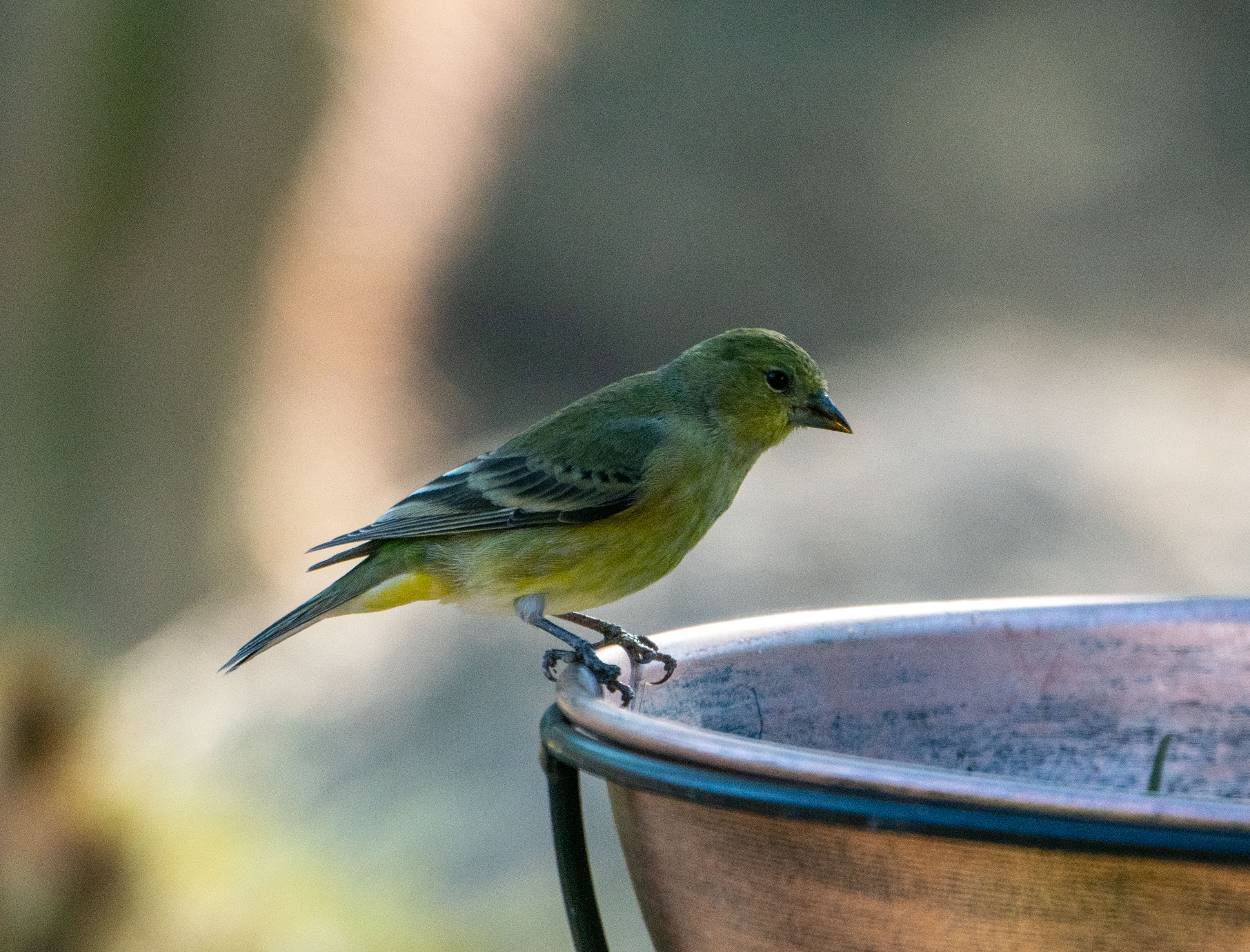
This is a female Bullock’s Oriole who stopped by our yard for the first time last week. She was very flighty and this is the only photo I captured. She’s hiding in a firestick plant.
Bullock’s Orioles can be found in forests, along streams and also thrive in desert washes in Mesquite trees and other desert plants.
Diet:
They eat insects and ripe fruits. Bullock’s Orioles also will stop by hummingbird feeders to drink sugar water. They forage for insects in the leaves and bark of trees.
Nests:
The female chooses a nest site typically 10 to 25 feet up in a tree. She will weave the nest from grasses, twine or wool. The nests are gourd-shaped and range in size from four to 15 inches. They line their nests with soft material like feathers, or “cotton” from cottonwoods or willows. They will work on the nest together, with one working inside and the other on the outside. Pairs will stay together long enough to build their nests and raise their chicks, but will find new mates the following year.
Size: They measure 11 to 12.5 inches (28 to 32 cm) in length, possess a wingspan of 19 to 23 inches (48 to 58 cm), and weigh between 4.5 and 6.5 ounces (125 to 187 grams).
White-winged Doves are very common birds in our backyard. The Mourning Doves outnumber them, but White-winged Doves are a close second. Their coloring is either brownish or gray. They have very noticable white tipped wings, bright blue eye-shadow and bright orange or red eyes. When they are in flight, their white wings are more prominent.
Diet: They are frequent visitors to our bird feeder and eat sunflower seeds and millet. In the wild, they eat seeds from desert willows, ocotillo, agave, as well as cacti fruit. They can fly up to 25 miles in the Sonoran Desert to look for water, plus get moisture from Saguaro cactus fruits.
Range: White-winged Doves have been seen as far north as Alaska, Maine and Ontario Canada, but are mostly found in the Southwest.
A White-winged Dove in our backyard tree.
Nesting: A female finds a location to build a nest such in vines, in thick desert brush, a clump of cactus or a tree limb. She builds a nest out of sticks that the male bird will bring to her. They are known to use their nest from a prior year, or they will reuse a nest from another bird. They are not monogamous for life, but more likely to stay together for breeding season.
House Sparrows are one of the most common birds we have. Their success in the wild is a result of their close relationship to humans. They are found in backyards, cities and throughout North America and most parts of the world. The House Sparrow was introduced in Brooklyn, New York in 1851. By 1900 they spread to the Rocky Mountains. They originated in Eurasia and North Africa.
Here’s a map of their range in North and South America:
This is a female House Sparrow on the birdseed block.
They are a small bird that has an average length of 16 cm and a mass of 24–39.5 g. Females and young sparrows are pale brown and grey, while males have brighter black, white, and brown markings.
They eat mostly seeds but will also eat insects as well as left over fast food from people or bread crumbs.
A House Sparrow visiting our birdbath.
They nest in manmade objects like eaves of houses, light boxes and planters. They also take over other birds nests in trees. A typical clutch size is three to four eggs and they may have several broods per year.
Three male sparrows splashing in the bird bath. House Sparrows are my most frequent visitors to the bird bath.
I spotted a new bird in our yard last week. This is a male Ladder-backed Woodpecker. It’s much smaller than my other woodpeckers, the Gila Woodpecker and Gilded Flicker. It was high up in a tree and I could tell it was a new bird by it’s shape. This was the only photo I caputured.
Here’s the info I found from All About Birds and Audubon about this small woodpecker:
SIZE:
Both Sexes
Length: 6.3-7.1 in (16-18 cm)
Weight: 0.7-1.7 oz (21-48 g)
Wingspan: 13.0 in (33 cm)
COLOR:
Ladder-backed Woodpeckers are black-and-white with ladder rung stripes on the back, and a more checkered pattern on the wings. The underparts are whitish or gray, flecked with black. The white face is broken by black lines that extend from the bill and eye. Males have red crowns; females have blackish crowns.
BEHAVIOR:
I learned from All About Birds that they forage in trees and bushes and are mostly hidden from view. That’s probably why I haven’t seen one until recently!
They live in hot arid areas such as deserts, pinyon forests, or dry scrub. They build nests in cavities in trees and cactus.
DIET: They mostly eat insects including caterpillars, ants and beetles. They also eat fruit and seeds, plus cactus fruit. They forage in tree bark, pecking with their beaks to find bugs.
We have an abundance of Mourning doves in our yard. It’s a common bird in our Sonoran Desert and throughout the USA and Mexico.
RANGE:
DESCRIPTION (from All About Birds):
“A graceful, slender-tailed, small-headed dove that’s common across the continent. Mourning Doves perch on telephone wires and forage for seeds on the ground; their flight is fast and bullet straight. Their soft, drawn-out calls sound like laments. When taking off, their wings make a sharp whistling or whinnying. Mourning doves are the most frequently hunted species in North America.”
Mourning doves are medium-sized birds of 9 to 13 inches (23 to 33 cm) in length and weighing between 3 and 6 ounces (85 to 170 grams).
A Mourning dove couple eating birdseed in our backyard. They are monogamous and mate for life, unless one of them dies. Then they will look for another mate. Mourning doves are known to be affectionate with each other and you can see them preening and hanging out.
It’s not unusual to see three flying in a tight formation during the breeding season. The bird in the lead is the mated male. A rival male will be in close second hoping to chase the first male from where he wants to mate and nest. The female, who is mated to the lead male, follows behind.
I cannot tell the difference between the male and females because they look very similar. According to the sources I read, the males are slightly bigger. They have a light blue patch on their head, and a peachy patch on their chest along with iridescent patches on the sides of their necks. The males are supposed to be more colorful, but I have never seen a difference with my naked eyes. I can spot a bit of blue and iridescent patches in my photos.
FOOD AND NESTING:
Ninety-nine percent of Mourning doves diet is seeds. They do eat a little fruit and snails.
In the West, Mourning doves may nest on the ground. In other parts of the country, they build nests in tree branches including evergreen, orchard tree, mesquite, or cottonwood. The male supplies the twigs, grasses or other material to the female who weaves it into a nest.
They have one to two eggs per clutch, but make up the small amount of eggs by having up to six broods per year.
CALLS:
One of my favorite sounds in our backyard is the coo-ing of Mourning doves. You can listen to their calls from All About Birds here:
Male and female House Finches on a cactus in our backyard. The male is the colorful one.
Bird of the Week: CLXXIII House Finch — Haemorhous mexicanus
SIZE: Sexes similar. 5-6 in (13-15 cm); wingspan: 8-10 in (20-25 cm); weight: 0.6-1 oz (17-28 g).
House Finches are a very common backyard bird. They are part of my daily birdwatching. All photos were taken in my backyard.
COLORING:
The males are brightly colored with a red eyebrow and forehead. Their throat and chest are red, lower underparts whitish, with dark stripes on their sides. I remember the first time I saw a House Finch, I was amazed by the bright red color. I was living in Palm Springs, California and saw one during my daily walk to the park. I thought it was some exotic bird, but found out it was a common House Finch.
A male House Finch on our cactus statue made of horse shoes. This is a good example of male coloring.
The females and young House Finches have plain brown faces, blurry stripes all over pale underparts. They’re very easy to overlook in our backyard compared to the males.
A female House Finch on a cactus. Notice the dull coloring compared to her mate.
RANGE AND HABITAT:
Originating in the Southwest United States, the House Finches are now common from coast to coast. I read that in the 1940s, New York pet shops released finches from their cages because it became illegal to sell them. They wanted to avoid prosecution. All these years later, the birds from those pet shops have grown in numbers and thrived.
House Finches can be found on farms, urban areas like city parks, backyards, as well as forest edges across the continent. In the western U.S., you’ll find House Finches in their native habitats of deserts, grassland, chaparral, and open woods.
FOOD:
House Finches are primarily herbivores. They eat seeds, grains, fruits and berries and a smaller part of their diet are insects like aphids. House Finches are regulars at bird feeders and especially like sunflower sees.
NESTING:
House Finches use a variety of sites, such as conifers, palms, cactus, holes in manmade structures, and may search around homes on ledges, window boxes or other safe areas preferring nests about 12-15 ft above the ground. Sometimes they use hanging planters and old nests of other birds. Nests are built mostly by the female. Nests are shaped like an open cup made from grass, weeds, twigs, and other plant material and sometimes with feathers or other debris.
House finches are monogamous through breeding season and the following winter. They may stay together for several years, but also may instead find new mates.
CALLS:
House Finches have an extensive warble and song similar to House Sparrows.
I call the Curve-billed Thrasher the bully bird of our backyard. With their curved strong beaks, they often intimidate other birds and take over the bird feeder. Once in the feeder, the Curve-billed Thrasher uses his beak to thrash back and forth through the birdseed. Most of it lands on the ground where our quail gladly gather.
Without our bird feeder, the Curve-billed Thrasher uses its beak to endlessly overturn ground in a sweeping motion foraging for insects, spiders and other food. This is similar to how they approach the bird feeder. They also eat the fruits and seeds of saguaro, prickly pear, and cholla.
Curve-billed Thrashers live in the desert Southwest of the United States and Mexico.
Map from All About Birds.
A Curve-billed Thrasher perching on a pink flamingo.
Measurements (both sexes):
Length: 10.6-11.0 in (27-28 cm) Weight: 2.1-3.3 oz (60.8-93.6 g) Wingspan: 13.4-13.6 in (34-34.5 cm)
They have strong legs, a curved beak, long tail and bright yellow orange eyes. The Curve-billed Thrashers in our Sonoran Desert are gray, but further south in Texas and Mexico they have lighter chests and are often speckled.
Curve-billed Thrashers mate for life and defend their territories that are five to 11 acres of desert land. They build nests in cholla or prickly pear cactus where the spikes protect them.