

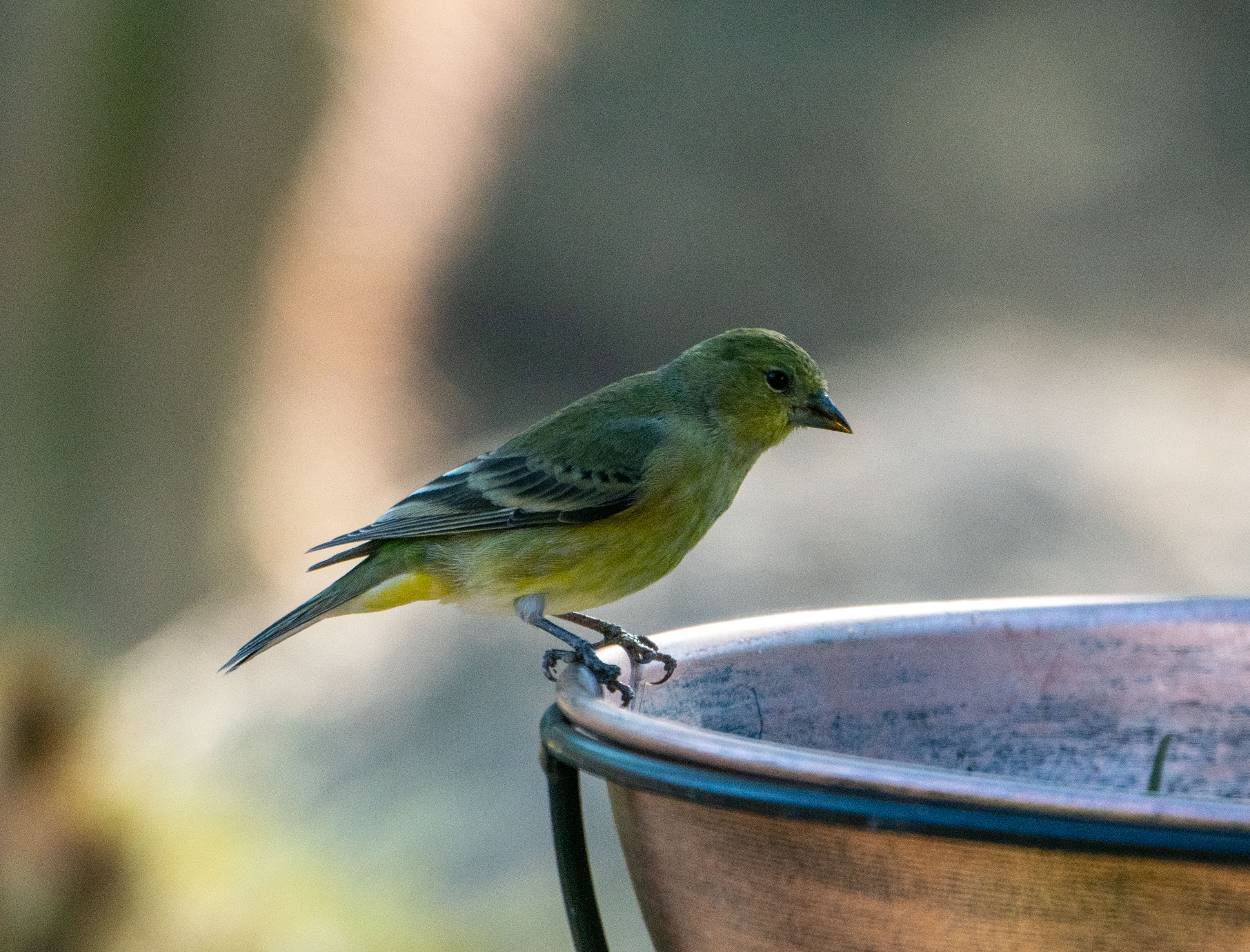
This is a female or juvenile Lesser Goldfinch who paid a visit to our birdbath yesterday. This is the first time I’ve seen one. I was pleased to have a new bird for Bird of the Week.
Lesser Goldfinch – Spinus psaltria
I learned that this goldfinch is called “Lesser” because it is smaller than its close relative the American Goldfinch. In North America, It’s the smallest goldfinch and one of the smallest finches.
COLORING:
While the males have black caps and white patches on the wings, the females and juveniles look just like the photo above with dull yellow underparts and an olive back. They also have two white wing bars.
SIZE:
Length: 3.5-4.3 in (9-11 cm)
Weight: 0.3-0.4 oz (8-11.5 g)
Wingspan: 5.9-7.9 in (15-20 cm)
LOCATION:
Lesser Goldfinches can be found in deserts, mountain canyons, weedy fields, in the brush of open areas and urban areas.

FOOD:
They mainly eat seeds from thistles and the sunflower family. They are attracted to backyard feeders especially with hulled sunflower seeds. Birdbaths are also a plus because of their diet of seeds. The Lesser Goldfinch needs hydration.
NESTING:
They do not mate for life, but stay together for breeding seasons and find a new mate the next year. The female chooses an area for a nest in trees or bushes. The nests are built four to eight feet off the ground in a protected area by leaves or branches. While the female builds the nest, the male watches.
She uses leaves, bark, cocoons, grasses and spiderwebs and weaves these together into a cup. The female lines the nest with hair, feathers, wool and fibers. Nests are about 3 inches wide and an inch deep. They have one brood per year with three to six eggs.
SOUNDS:
https://www.allaboutbirds.org/guide/Lesser_Goldfinch/sounds


