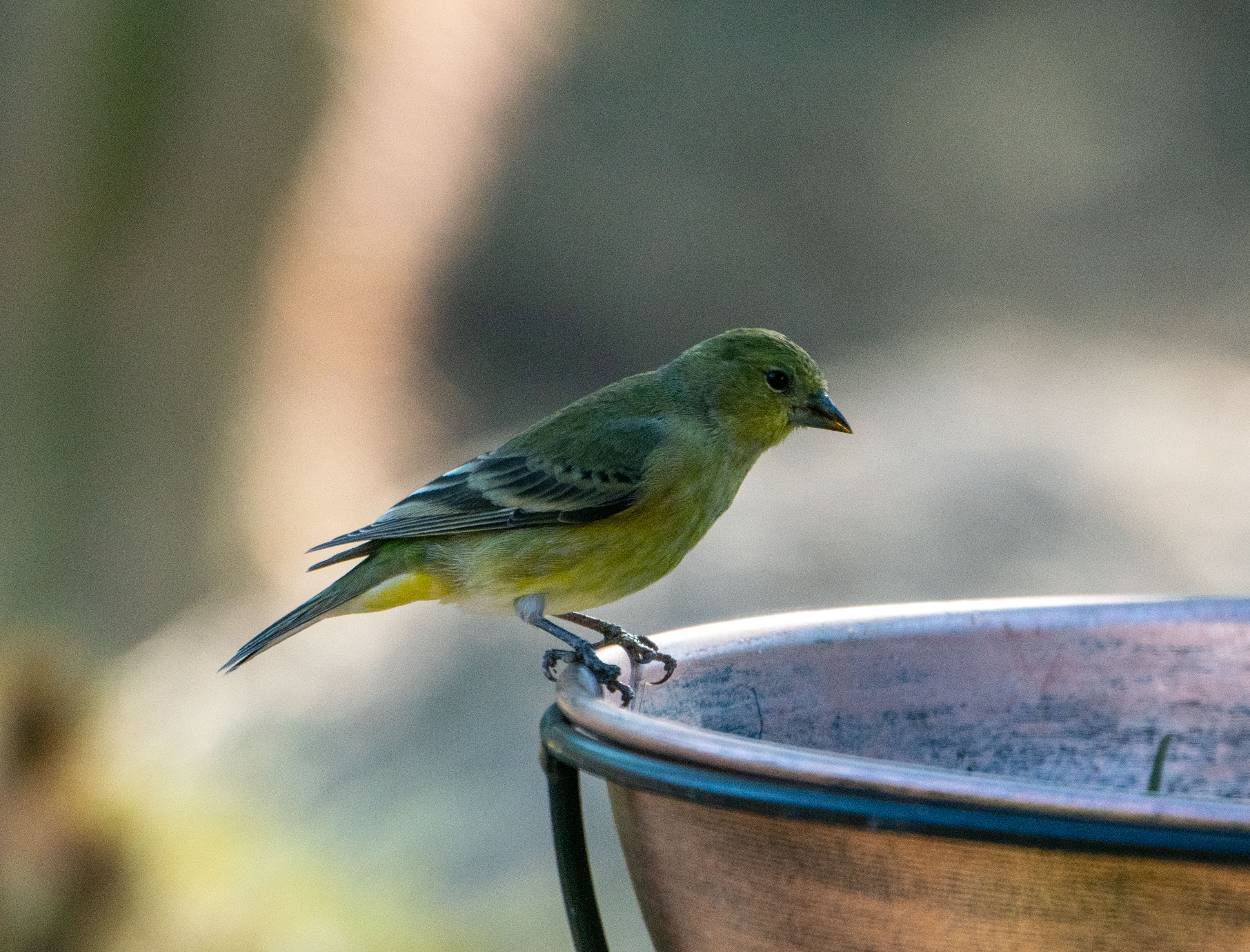
This is a fledgling who appeared with Red in my Wednesday post. This is such a fun year with a possible three babies to watch with Red and Mrs., my backyard cardinal couple.
Add to that multiple quail families with babies ranging from brand new and itty bitty to rangy teens.
Baby quail.
Papa guarding his babies.
A family of older babies hanging out in the shade under a bench with daddio. Smart birds! It’s gotten hot!
These are the itty bitty babies.
Then there’s the backyard bully bird — the Curve-Billed Thrasher. He doesn’t look so mean perched on a pink flamingo a friend gave me from Costco for a birthday present.
A female Gilded Flicker can make a quick dent in the food block.
Do you have a favorite photo? If so which one?
What’s on the agenda for the first weekend of June?
This is one of two Northern Cardinal fledglings that made an appearance in our yard this past week. He’s with his dad. Although the coloring of the fledgling looks like an adult female, fledglings beaks are gray or black while the adults’ beaks are bright orange.
The Latin name for the northern cardinal is Cardinalis cardinalis.
This is the smaller fledgling. They are gray until about three months when their coloring appears. Until then I won’t know if these are males or females. If they are male they will get splotches of red. If female, they’ll get the orange highlights of the female adult.
This is Mrs., our adult female cardinal and mom of the two fledglings.
We have had a cardinal male and female in our yard for two years. I’ve named them Red and Mrs. I’ve been waiting patiently to see if they’d have a family, and I’m beyond excited to see their fledglings.
The female lays three to four eggs and incubates them by herself for 12 to 13 days. The young leave the nest in about nine to 11 days after hatching. Once they leave the nest, they are called fledglings. Both parents feed their young but often it is the father.
Here’s Red feeding his large fledgling.
Fledglings will often hide in bushes or shrubs while most often the male will feed them for a few weeks. They become fully independent after about a month. I am curious if they will stay in our yard, or will find their own home away from their parents.
UPDATE:
A day after I wrote and scheduled this post, I saw Red with a brand new fledgling or possibly fledgling number 2 who I named “Mini me”. Here are a few photos:
The way the baby moved and was so shaky standing while I got photos gave me the idea that it may be Cardinal fledgling number three. I read that eggs are laid over time and they may hatch over several days or even weeks, which is why they can be different ages and sizes.
I have gotten comments on my Next Door app and friends that fledgling number one is the adult female. The color of the beaks, black vs. orange, plus and seeing Mrs. in the backyard with fledgling number one lets me know for sure that they are separate birds
What do you think of my Cardinal Fledglings? Do I have one, two or three?
I took quite a few photos of Red this week. He was a frequent visitor. I had two close encounters with him that were special moments. Both times I could hear him loudly chirping away. When he does that I believe he is calling me to fill the bird feeder.
I walked outside to the feeder with birdseed and called out, “Hey, Red,” as I always do when he’s chirping at me. I couldn’t see him but then he flew straight to me from the neighbor’s yard. He landed in a bush next to the bird feeder a couple feet away from me.
Red has landed in this planter a few days in a row. I’m wondering if there are some natural seeds or things to eat in it. In any case, it makes a pretty picture.
This is kind of a strange photo. Red swooped down to the birdseed block to take a bite of goodies while still flying!
The other close encounter with Red was I saw him blast off like a rocket flying over our fence to the wash behind us. I called, “Hey, Red!” He made a U-turn in the air and flew back to where I was standing. Once again he landed in the bush by the bird feeder.
It felt really special to have my friendly Red come to me when I called him. Or, maybe he just likes me for my birdseed.
I call the Curve-billed Thrasher the bully bird of our backyard. With their curved strong beaks, they often intimidate other birds and take over the bird feeder. Once in the feeder, the Curve-billed Thrasher uses his beak to thrash back and forth through the birdseed. Most of it lands on the ground where our quail gladly gather.
Without our bird feeder, the Curve-billed Thrasher uses its beak to endlessly overturn ground in a sweeping motion foraging for insects, spiders and other food. This is similar to how they approach the bird feeder. They also eat the fruits and seeds of saguaro, prickly pear, and cholla.
Curve-billed Thrashers live in the desert Southwest of the United States and Mexico.
Map from All About Birds.
A Curve-billed Thrasher perching on a pink flamingo.
Measurements (both sexes):
Length: 10.6-11.0 in (27-28 cm) Weight: 2.1-3.3 oz (60.8-93.6 g) Wingspan: 13.4-13.6 in (34-34.5 cm)
They have strong legs, a curved beak, long tail and bright yellow orange eyes. The Curve-billed Thrashers in our Sonoran Desert are gray, but further south in Texas and Mexico they have lighter chests and are often speckled.
Curve-billed Thrashers mate for life and defend their territories that are five to 11 acres of desert land. They build nests in cholla or prickly pear cactus where the spikes protect them.
“Our debt to the heroic men and valiant women in the service of our country can never be repaid. They have earned our undying gratitude. America will never forget their sacrifices.” — Harry S. Truman, 33rd U.S. president, 1945
I spent a quiet Memorial weekend with my husband who is now on week three post surgery. I took a few photos that I was pleased with and will share some today.
I read two books this past week by fellow bloggers and enjoyed both immensely. If you haven’t read Cupcakecache’s second book, “Quest for Absence,” you should! I read it within two days and couldn’t put it down. This is Eve Marie’s second book in what will be a trilogy starting with Bayou Heist. Many of the same characters appear in her second book but it’s placed in the home of her youth, Catskills of NY. I enjoyed her setting and getting more details into the story and plot she wrote about in her first book.
The other book is “Perfect” by P.J. Gudka. Pooja’s blog is Lifesfinewhine. I usually go to bed between 8 or 9 p.m. but I read until midnight to finish her book. I fell asleep on the sofa and finished it the next day. The characters and plot kept me enthralled. I learned about “Perfect” by a Heart of the Matter podcast and also on Lauren Scott’s blog Baydreamer Writes for her review on her blog post.
Both books are on Amazon plus Pooja has a link on her website.
Two brand new baby quail. I tried to get photos with their mom, but either the babies or the mom were out of focus. These guys are super tiny!
A House Finch couple on a cactus.
A momma quail with her brood. These are older than the two babies above.
A momma quail trying to scare away a squirrel by fluffing up her feathers. Papa quail is in the background as reinforcement.
Americans began to recognize Memorial Day in 1868, and the country established it as a federal holiday in 1971. Originally known as “Decoration Day,” the holiday started with communities coming together to decorate the graves of those who died during service.
Theories of the first Memorial Day
After the Civil War, Americans across the nation began holding tributes to honor the approximately 620,000 soldiers who lost their lives — about 2% of the population at the time. These early observances typically included decorating graves with flowers, reciting prayers, and paying respect to the fallen. But history records show more than one theory about which event marked the first official Memorial Day.
A discovery by a Yale University professor at a Harvard archive suggests the earliest observance of Memorial Day was held by a group of formerly enslaved people in Charleston, South Carolina, in 1865. Records show that the group transformed a racetrack that had once served as a prison for Union captives into a proper burial site.
On May 1, 1865, thousands gathered for a procession led by 3,000 school children carrying flowers and singing patriotic songs.
In 1966,the federal government declared Waterloo, New York, the official birthplace of Memorial Day when President Johnson signed a presidential proclamation stating Waterloo celebrated the first Memorial Day. That day, in 1866, the city closed all businesses so residents could decorate the gravesites of soldiers with flowers and American flags.
Other records show that the first Memorial Day came after the Civil War, when communities came together at Arlington National Cemetery on May 30, 1868. It remains one of the country’s most notable Memorial Day ceremonies.
But the history doesn’t end there: As recently as the 1990s, historians have found records of earlier celebrations.
Happy Memorial Day!
Here’s a video of a family of quail including 10 babies!
What were some highlights of your Memorial Weekend?
I took this photo of a Harris’s Hawk on our neighbor’s roof. This is my favorite photo of a Harris’s Hawk that I’ve taken. We had a visit yesterday by two of these large predators in our backyard. But I wasn’t quick enough with my camera to get decent photos. I took all of these photos during the past year.
Harris’s Hawks live in the Southwest United States and South America. They do not migrate but stay in the same location. Map courtesy of All About Birds.
Harris’s Hawks are 18-24 inches in length and weigh from 1.5 to 2.5 pounds. Their wingspan is three to four feet. The females are larger than the males.
Their coloring is dark brown, chestnut red, and white; long yellow legs; and yellow markings on its face.
These hawks mate for life. They are very social birds and hunt in pairs and groups up to seven hawks. I have had six hawks in my backyard at once. When hunting, they may take turns chasing their prey and one bird may flush out their target while others will attack. They feed on small animals including lizards, rabbits, doves, quail and other birds.
A Harris’s Hawk taking off in flight.
A hawk in a tree in our backyard.
There were four hawks perched on this Century Plant at once, but I found the more exciting photo to be with one in flight and one hawk remaining on the plant.
I was thrilled to see this cactus in bloom. But then a rabbit stopped by and ate the bud on top. It didn’t get a chance to bloom.
Red was mixing it up with the quail families.
One of the many families of quail who stopped by over the weekend. We have families with tiny babies up to teenagers now. The smallest family has two babies, another has three, then we have those with six, seven up to 10 babies.
A lone baby quail. One little guy flew up to the windowsill and hung out by me.
I took this with my iphone sitting at my little table. Eventually he flew down to catch up with his siblings and mom and dad.
I’m not sure, but I think this is a Desert Spiny Lizard after looking at photos of Arizona lizards.
A House Finch observes the scene in the backyard. It was a busy weekend for birds. I did get a photo using my iphone of a Harris’s Hawk eating it’s kill on top of a saguaro. But I thought better of sharing it. It’s kind of gross looking.
Red says “What are you guys looking at?”
I have a week of doctors appointments and driving my husband to PT. I even have one appointment for myself.