The quail are always in our backyard. There are so many families with mom and dad and a batch of babies that I can’t keep track. One family has two babies. Another has 10 or 11 and there are families with every number in between.
The poppa quail usually finds a perch on a bench or rock to have a good view of his family while they scratch around for birdseed in the gravel, or visit the birdseed block.
A pretty momma quail mostly stays with her babies. I see the moms calling out to them to round them up and keep them close by.
Here’s a teenager quail. There are very few little itty bitties around anymore. They grow up so quickly!
Here’s a group of babies hanging out in the shade of a barrel cactus.
Three young ones making their move to the bird seed block.
This teenager has legs!
Another poppa quail on the lookout for his family.
I will miss these quail families when the babies are all grown up and they start their own family units. That will be next spring.
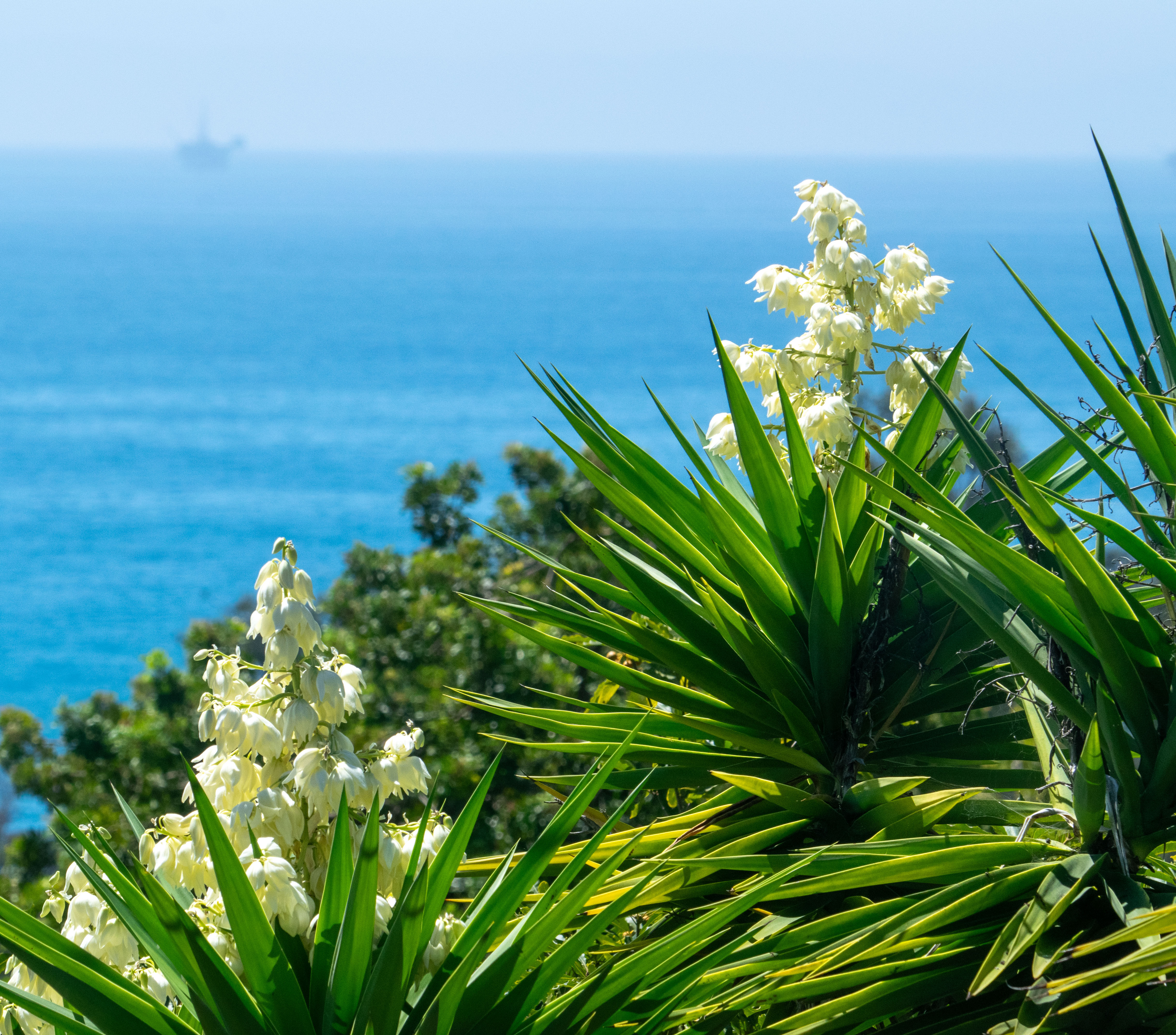
This is a yellow Century Plant in full bloom in our yard.
From Planet Desert:
The yellow century plant (often known as the Variegated Century Plant or Agave americana ‘Marginata’ / ‘Variegata’) is a massive, drought-tolerant succulent . It features striking, blue-green foliage lined with bright yellow or cream margins and sharp marginal teeth. It thrives in arid environments like Scottsdale and needs minimal watering once established .
It was called a Century Plant because it was believed to bloom once every hundred years. What I learned is it blooms once in its lifetime once it’s a mature plant which happens around 15 to 30 years. Then it dies.
These two photos give you a perspective of what the plant and stalk look like. A neighbor pointed out my beautiful yellow blossoms next to our driveway. I hadn’t noticed the blooms because it’s tucked away behind a saguaro and other plants.
More from Planet Desert:
A century plant (Agave genus) typically dies within a few months after it finishes blooming. Because it is a “monocarpic” plant, it puts all of its remaining energy into creating a massive central flower stalk.
Once the seeds have developed and ripened, the entire plant withers and dries up.
While the mother plant dies, the lifecycle continues through offshoots, commonly known as “pups” or “hijos,” which grow at the base of the plant.
It is bittersweet that such a beautiful plant will be dying soon. I felt sad taking photos of it. My neighbor has one ready to bloom in her yard. As an artist, she said she’ll be take photos that she’ll use for a painting. Through our photographs and paintings, the Century Plant will live on.
What are your thoughts about Century Plants? Have you heard of monocarpic plants?
I got quite a few good photos of Red and Mrs. I saw them every single day, but not a glimpse of their fledglings. I wonder if they flew the nest and are living life without mom and dad?
We had an amazing evening with Red. I spotted him on the fence to our courtyard outside our front door. I talked to him, calling “Hey Red.” I went inside and told my husband. He suggested we sit in the courtyard and hang out with Red. We enjoyed the sun with Red flitting above us. Red flew into the tree we were sitting under. He flew to the wall, the fence and back up into the tree, singing to us. He called for Mrs. and she joined our group. We hung out with them for half an hour and finally went inside.
I took this with my iphone, so the quality isn’t that great. But you can see how we got to hang out with our friendliest bird Red.
Here’s one of the photos I took of Mrs. this week. I’m liking this week’s photos because of the clarity of my subject birds (not the ones in the background.) This is thanks to my photographer friend Gary Gruber. He suggested a few weeks ago that I change my settings to a faster shutter speed.
A gilded flicker stopped at the birdbath in the morning light.
A White-winged dove was hanging out for a day.
The resident bully bird, a Curve-billed Thrasher, loves to throw his beak around and intimidate the other birds.
Papa quail with his babies having a word with Red.
I had a first time visitor to the birdseed block. This is Albert’s Towhee. I used his call on my Merlin app to identify him and then went to All About Birds to ID him according to his looks.
I got this closeup of a quail dad’s face and fluffy feathers.
Which photo or photos are your favorites?
What are your weekend plans?
Do you have anything special planned to celebrate July 4th plans?
It’s been more than a year since I fell hiking and broke my fibula. I remember post surgery, while I was struggling with my walker and wearing a boot, I would write my morning pages (from Julia Cameron’s “The Artist’s Way”) out by the pool, with my coffee and water. It was a highlight of those tough days — quiet time outside, listening to birds in the fresh air and sunshine.
It occurred to me over the weekend that I can still enjoy those mornings outside writing my morning pages. Here’s to more time outside in nature!
This is my sad ankle. I had a one-year checkup and x-ray. No wonder my ankle feels a little stiff. I’m doing my PT exercises to keep it moving.
I pulled out my old canvas ballet slippers and thought I should go back to tendus and pliés. I used to take ballet four days a week as an adult in Palm Springs. I began at age five until fifth or sixth grade when I got my first pointe shoes. I loved it, but a shoe fell out of my bag and was lost. My mom said, “You obviously aren’t interested anymore.” And that was that. I was supposed to be taking a minimum of classes three days a week or more. Mom was driving me to Bellevue which was 40 minutes away from home. I think she was tired of the commitment — especially if she thought I wasn’t interested.
As soon as I was at the University of Washington, I enrolled in ballet. I continued until my unfortunate accident when I was a pedestrian hit by a pick up truck. Then I picked it up again as an adult before kids and continued into my 50s until my ballet class ended and I couldn’t find another one in the area for adults.
I realized I could do this on my own. I can follow Youtube videos or make my own barre routine. Then, if I’m feeling motivated, I can go to the gym for barre class also. It’s plan!
Red in the morning light visiting his flamingo friend.
What little things do you enjoy that improve your daily life?
I captured the morning light in this bunny’s ears. We have bunnies everywhere, but I mostly see them on my morning walks as they dash across the road. They are frightened of big old me!
I was sitting in the waiting room of my husband’s PT yesterday, looking through the week’s photos I had captured. I am sharing the ones I like best — that didn’t make it into Monday or Wednesday’s posts. Enjoy a few of my week’s favorite photos.
It looked like Red was having a bad hair day or for some reason fluffed himself up.
A Mourning Dove looking grand in our backyard.
We don’t often see these guys. I looked up Arizona black bird with black beak and yellow eye. Grackle is what came up.
A rare appearance to see Red and Mrs. in the backyard at the same time — without any fledglings.
A quail baby growing up. They do grow up so quickly!
This was a baby pic I took a few weeks ago. We don’t have any quail this tiny anymore.
Here’s Red a few seconds after the fluffy look. Does anyone know what the fluffy feathers is about?
Male and female House Finches on a cactus in our backyard. The male is the colorful one.
Bird of the Week: CLXXIII House Finch — Haemorhous mexicanus
SIZE: Sexes similar. 5-6 in (13-15 cm); wingspan: 8-10 in (20-25 cm); weight: 0.6-1 oz (17-28 g).
House Finches are a very common backyard bird. They are part of my daily birdwatching. All photos were taken in my backyard.
COLORING:
The males are brightly colored with a red eyebrow and forehead. Their throat and chest are red, lower underparts whitish, with dark stripes on their sides. I remember the first time I saw a House Finch, I was amazed by the bright red color. I was living in Palm Springs, California and saw one during my daily walk to the park. I thought it was some exotic bird, but found out it was a common House Finch.
A male House Finch on our cactus statue made of horse shoes. This is a good example of male coloring.
The females and young House Finches have plain brown faces, blurry stripes all over pale underparts. They’re very easy to overlook in our backyard compared to the males.
A female House Finch on a cactus. Notice the dull coloring compared to her mate.
RANGE AND HABITAT:
Originating in the Southwest United States, the House Finches are now common from coast to coast. I read that in the 1940s, New York pet shops released finches from their cages because it became illegal to sell them. They wanted to avoid prosecution. All these years later, the birds from those pet shops have grown in numbers and thrived.
House Finches can be found on farms, urban areas like city parks, backyards, as well as forest edges across the continent. In the western U.S., you’ll find House Finches in their native habitats of deserts, grassland, chaparral, and open woods.
FOOD:
House Finches are primarily herbivores. They eat seeds, grains, fruits and berries and a smaller part of their diet are insects like aphids. House Finches are regulars at bird feeders and especially like sunflower sees.
NESTING:
House Finches use a variety of sites, such as conifers, palms, cactus, holes in manmade structures, and may search around homes on ledges, window boxes or other safe areas preferring nests about 12-15 ft above the ground. Sometimes they use hanging planters and old nests of other birds. Nests are built mostly by the female. Nests are shaped like an open cup made from grass, weeds, twigs, and other plant material and sometimes with feathers or other debris.
House finches are monogamous through breeding season and the following winter. They may stay together for several years, but also may instead find new mates.
CALLS:
House Finches have an extensive warble and song similar to House Sparrows.
One of three Cardinal fledglings of Mrs. and Red. I can’t get over how exciting it is to see their family after my favorite bird couple have lived in our yard for two years.
Yesterday was what I called “Prep Day” for a medical procedure we are encouraged to do at age 50 and every 10 years afterward — if all is clear.
My day included a liquid diet of Jell-O, broth, apple juice, ginger-ale and tons of water. Accruements included one full bottle of Mir-a-Lax powder (14 days worth) mixed with Gatorade along with Dulcolax. For dessert there was magnesium citrate taken at 2:30 a.m. this morning.
Red keeping an eye on his baby. Red has daily tasks with his fledglings in our yard. Look at how short the baby’s tail is. It will grow as he or she gets older. We have to wait for red blotches before we know for sure if it’s a boy or girl.
I talked to my friend in Santa Barbara who said, “Thank goodness they no longer make you do all that prep.”
“Really?” I guess different doctors have their own protocols. I told her my regimen for Prep Day and she said she didn’t have to do that except wake up in the middle of the night for magnesium citrate.
I mentioned to my son about my upcoming procedure and said, “I see all these ads on TV that you can do a simple blood test instead. I’m going to opt for that.”
He told me that his wife did a blood test. Her doctors told her she was fine. Until she wasn’t and was in ER in excruciating pain. They finally discovered she had cancer that was bumping up against Stage 4.
Consider that as your Public Service Announcement for when you hit 50 years old and beyond.
So I went through craving solid food, being hungry for a day and all that annoying prep to make sure. Here’s to a good outcome, fingers crossed, and ten more years!
It seems we are going to doctors more and more as we get older. Or maybe it’s just the recent ankle and foot surgery and my husband’s knee replacement plus endless PT. I can’t wait to get through my battery of healthcare appointments and have some fun!
On Another Note:
Before I schedule my posts, I read them over and edit. Sometimes I get blocked. Two to four icons of my face pop up and I get a message that there are too many contributors.They are little markers with my face and name. There’s no way to save what I’m working on. My choice is to exit and leave with unsaved changes. Also there’s a button to copy the post. But it doesn’t work. It’s very annoying.
Has anyone else had this issue in WP? Do you have other WP issues lately?