What do you think about unsolicited advice?

My kids

My kids

I wrote this post about unsolicited advice several years ago. I keep on repeating the same mistake. When my kids are going through an uneasy time, I jump with advice on what they should do. This especially angers my daughter and she snaps at me. My so will listen calmly and then ignore whatever I have to say. I really need to stop this constant need to fix everything in my children’s lives! They need to experience life and learn on their own. Mommy can’t do it for them. Here’s the story I wrote about unsolicited advice:

A few weeks ago, my daughter was telling me how she’d missed practice because she had a midterm and the time conflicted. Her coach wasn’t happy, she said.

“Well,” I said, “maybe you should call her and explain. Or, better yet, next time you’re going to miss practice, let her know in advance.”

“Mom, I’m telling you something. I don’t need your unsolicited advice. A simple ‘that sucks’ would suffice.”

I was offended. My feelings were tweaked, not exactly hurt. I thought, what is going on with her?

This week she called and asked for my advice about a sticky situation with a friend. I get it now. She had a problem she couldn’t solve on her own. She wanted my advice and then she would handle it from there.

In her dorm room getting settled.

In her dorm room getting settled.

My mistake has been offering advice when my perfectly capable, adult child is making her own decisions and finding her own way. She does not need her mom telling her what to do all the time.

This was reinforced again when she called with an issue with her university and paperwork for the fall quarter. I gave her a few suggestions of who to call, what to do.

“I’ve done all that, Mom. I’m just telling you about it.”

Yes, I understand now. She’s sharing the trials and tribulations in her life. She’s not asking me what to do. If she needs my help she will ask me.

With teammates after breaking the 8 and under 4 x 50 relay record.

With teammates after breaking the 8 and under 4 x 50 relay record.

I should be thankful that my daughter likes to share. That she can figure things out on her own. That she’s got a strong head and can handle the daily tasks of living in a house, paying utility bills, handling school bureaucracy, and getting a speeding ticket.

Welcome to adulthood! I guess a simple “that sucks” from time to time is all she needs.

How do you handle unsolicited advice when someone offers some to you?

True Confessions of a Helicopter Mom

My kids and their teammates at a meet in Irvine years ago.

My kids and their teammates at a meet in Irvine years ago.

There’s a study from BYU that says that helicopter parents are hurting their kids. You can read more about it here.  The study says that even loving parents don’t make up for the damage inflicted by excessive hovering.

I don’t know if I’d call myself a helicopter parent or not. My kids would probably say yes, but as one swim coach told my daughter, we are far from the worst parents he’s met.

To try and determine my status I took this quiz from the Christian Science Monitor.

I earned Terra Firma.

13e7cdf4346de40aade6db55399ea91eMy two kids are so different, I question if I parented them differently? I feel like I helicoptered my first born, and was more laid back with the second. The result is one more dependent and one independent.

I used to boil my son’s binky’s after they hit the ground for a good five minutes. I’ll never forget that smell of burning rubber when the water boiled away. The joke my husband used to tell was that with our second child, I asked the dog to “fetch” the binky.

Binky's

Binky’s

When my son was born, I worked on my writing and PR business from home. I thought I could full-time parent and work simultaneously. I didn’t take into consideration that clients would want to me run over for meetings without notice.

Then, Robert went mobile. He was crawling around. Spitting-up on my keyboard.

Nope, full-time work and stay-at-home parenting didn’t work out well for me. I hired a full-time babysitter and then became jealous every day they left for the park.

Three years later, when my daughter was born, the full-time help was gone, and I switched to part-time work. I was able to spend time with the kids, and do a little work, too. It was a nice balance.

Early on, I volunteered in my son’s classroom. I corrected papers, taught computers, writing. Anything they’d let me do. I’ll never forget arguing with his second-grade teacher over the word “artic.” After all, I had drilled him the night before on the continents. “It’s arctic,” the teacher told me. Oops.

My son constantly asked me to bring things to school. Papers he forgot. Projects left behind. I always dropped what I was doing and drove to school—including during his senior year! I can’t believe I did that! I did not do that for my daughter. Mostly, because she never asked.

I helped out with her schooling, too. But, in her elementary school years, it was limited to driving for field trips and special events.

I have one child that now calls whenever there is a problem. His face pops up on my phone and I automatically ask, “What’s wrong?” A broken computer, a fender bender, a parking ticket. It’s always something. Of course, there are exceptions—he aced a test, or got asked to be a guest speaker by the Dean at a fundraiser.

My daughter calls once a week or so to talk to tell me how she’s decorating her room, about a backpacking trip to hot springs, or that she had a good workout.

Maybe the difference between my kids is this: they are entirely two different people, with different goals, personalities, and interests. 

As far as my being a helicopter parent? I think I improved over the years.

How do you define if you’re a helicopter parent? What things have you done that are over the top?

My two kids.

My two kids.

5 Tips for Parents of Graduating Seniors

Here’s a story I wrote a few months before I officially became an “empty nester.” Many of my friends are going through the transition from full-time parents with their kids graduating high school and starting the next phase of their lives. This story is for anyone facing the empty nest or having their oldest child graduating high school. Trust me, it gets better and you’ll learn to love some “me” time.

I’ve written about the top 10 things kids need to know before leaving for college. But, what about us? When our kids leave, it’s a drastic change in our lives.

IMG_1743

When we took our son, our oldest child, to University of California Santa Barbara, I was strong. I was emotional about moving him into the dorms, but I was excited for him, too. I loved college. They were some of the best years. I was excited for him to love it, too.

But, then we said our good-byes. It hit. Like a punch in the stomach. Then, the tears. Oh, my! I wasn’t expecting that. The drive home, my younger child, age 15, looked at me in horror. I was falling apart. Thank goodness for her riding in the car with me. I probably would have wailed like a complete idiot without her staring at me.


IMG_1721

My son on our friend’s sailboat during orientation weekend.

Now, I have a few months left before I face a totally empty nest. What did I learn the first time around to prepare me for this time?  I wish I knew some secret to make it easier.

During orientation, UCSB gave parents a few tips on how to parent your college kid. This is what I remember:

1. Give them space. Don’t hover, don’t call too often, never call before 10 a.m.

2. Set up a time to make calls on a weekly basis — and not more often than that.

3. Expect them to get homesick. It’s natural they will miss home-cooked meals, their own room, their friends, pets, and you!  Reassure them that this is normal. They tend to get homesick around six to eight weeks. It will get better. They’ll adjust. But, will you?

4. Be sure to send a few care packages. Their favorite cookies, toiletries, something to make them smile. Mid-terms and finals weeks are ideal times to mail care packages.

5. Take time for yourself! Write, paint, sew, take a yoga class. Do something every week for just you. Make a list of things you used to love doing, but through the child-raising and working years, haven’t found time to do. Make another list of things you’ve always wanted to do, but haven’t. You’ll find your way.

IMG_2265

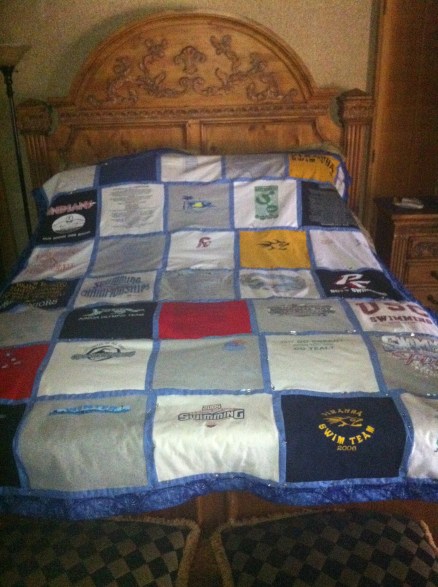
The quilt I made my son out of his swim tee shirts.

IMG_2339

My kids not wanting me to take their pic on the UCSB campus.


How Is Coaching Like Parenting?

kat ann

My daughter with a former coach.

I found an interesting article on a website The Ozone called “Morning Conversational: How Is Coaching Like Parenting?” by Tony Gerdeman.

I’ve always wanted to know, do coaches recruit the athlete? Or do coaches look at the entire family? Should that determine how we act or behave at meets? Is there something we parents should be aware of during the recruiting process? What I’ve discovered does come into play is that when we are away, back home–and our kids are at school on a team–often the coaches take our places as semi-parental units. Coaches are the adult figures in a position of authority. They make take our place as a sounding board, confidant, and guide.

From the article about how coaching is like parenting:

When recruiting players, coaches from all sports have to also recruit players’ families.

They want to know what kind of son or daughter, or brother or sister they are recruiting. A son that doesn’t respect his family is generally going to be a player that doesn’t respect his coaches.

A couple of years ago, Ohio State running backs coach Tony Alfordtold a story about recruiting Ezekiel Elliott when he was at Notre Dame, and how he still remembered the interactions he saw between Elliott and his sister and how he could tell just through those moments that Elliott was the type of person he would like to coach.

When parents and guardians then sign off on their sons and daughters going to a particular school, they don’t do it thinking their child is going to be running amuck and without any supervision.

It is at this point when coaches stop being recruiters and become extended parents. Most players are too far from home to visit when they’d like, so coaches have to fill those needs where they can. Including providing the occasionally needed tough love.

Coaches — like parents — have to be consistent, however.

“Coaching is no different than parenting. Everyone is treated fairly,” Alford said this spring. “People say, ‘I’m going to treat you all the same.’ You’re not. You’re not going to treat them all the same. I don’t treat my children all the same. I’ll treat them fairly. And the expectation levels are all the same.

“The way I talk to Master [Teague] is vastly different than the way I talk to Demario [McCall]. Or how I talk to JK [Dobbins]. The way I talk to Mike Weber is very, very different than how I talk to Marcus Crowley. But you have to know your players, you have to know your clientele, you have to know your kids, and what’s going to push them.

“And if they need something mentally, then how do I make that happen for them? How can I help facilitate that? And make them understand, ‘Here’s where you’re at, here’s where we have to go, and here’s how we’re going to do it.’ And every kid is a little bit different.”

When I interviewed several coaches for an article for SwimSwam magazine, I found that coaches weren’t that interested in how parents behave during the recruiting process. Instead, coaches were far more interested in how the kids treated their parents. Jeanne Fleck, head coach of the Fresno State Bulldogs, said she watched in horror as one recruit screamed at her mom over the phone. Fleck thought that she’d pass on that swimmer because of her actions. She said she becomes a mother figure as much as a coach and she definitely wasn’t thrilled at the prospect of being treated by that athlete the same way she treated her mom.

When going through the recruiting process with our kids, we want coaches our kids will look up to. We want them to develop a mutual relationship of respect. If we’ve done our jobs well, our kids won’t be horrifying prospective coaches with their nasty treatment of others. Instead, they’ll impress with their kindness and warmth.

18920513_10213697294250428_7072346138704993087_n

My daughter with her college coach.

What are your thoughts about coaches and parents and their roles?

Crossing the line from helping to hurting your kids: from helicopter to snowplow

kiddos

My kids making good use of their super powers.

Everyone I talked to was shocked about the parents who paid bribes to get their kids into college. It made me unbelievably angry–and a lot of my friends, too. What kind of person would do that?

A lot of us are helicopter parents, yet we’d never dream of going that far. The ‘paying to get your kids into a good school’ is a matter of degree of helicoptering or snowplowing. If you’re a mom who wouldn’t let your kids fail before college and were running to school with forgotten homework then it’s a matter of crossing a line — albeit one that is unethical and illegal — to bribing a college coach to let your kid get admission to the school. (Yes, I was the parent driving homework to school, including my son’s senior year of high school!)

In a New York Times article called “How parents are robbing their children of adulthood” by Claire Cain Miller and Jonah Engel Bromwich, they talk a lot about “Today’s ‘snowplow parents’ who keep their children’s futures obstacle-free — even when it means crossing ethical and legal boundaries.”

Here’s an except:

Helicopter parenting, the practice of hovering anxiously near one’s children, monitoring their every activity, is so 20th century. Some affluent mothers and fathers now are more like snowplows: machines chugging ahead, clearing any obstacles in their child’s path to success, so they don’t have to encounter failure, frustration or lost opportunities.

Taken to its criminal extreme, that means bribing SAT proctors and paying off college coaches to get children in to elite colleges — and then going to great lengths to make sure they never face the humiliation of knowing how they got there.

Those are among the allegations in the recent college bribery scandal, in which 50 people were charged in a wide-ranging fraud to secure students admissions to colleges. According to the investigation, one parent lied about his son playing water polo, but then worried that the child would be perceived by his peers as “a bench warmer side door person.” (He was assured that his son wouldn’t have to actually be on the team.) Another, the charges said, paid someone to take the ACT for her son — and then pretended to proctor it for him herself, at home, so he would think he was the test-taker.

The parents charged in this investigation, code-named Operation Varsity Blues, are far outside the norm. But they were acting as the ultimate snowplows: clearing the way for their children to get in to college, while shielding them from any of the difficulty, risk and potential disappointment of the process.

In its less outrageous — and wholly legal — form, snowplowing (also known as lawn-mowing and bulldozing) has become the most brazen mode of parenting of the privileged children in the everyone-gets-a-trophy generation.

It starts early, when parents get on wait lists for elite preschools before their babies are born and try to make sure their toddlers are never compelled to do anything that may frustrate them. It gets more intense when school starts: running a forgotten assignment to school or calling a coach to request that their child make the team.

Later, it’s writing them an excuse if they procrastinate on schoolwork, paying a college counselor thousands of dollars to perfect their applications or calling their professors to argue about a grade.

katrob

The pre-school, elementary school years.

The article goes on to discuss how the recent college cheating scandal shows how current parenting practices have gone off the deep end:

The bribery scandal has “just highlighted an incredibly dark side of what has become normative, which is making sure that your kid has the best, is exposed to the best, has every advantage — without understanding how disabling that can be,” said Madeline Levine, a psychologist and the author of “Teach Your Children Well: Why Values and Coping Skills Matter More Than Grades, Trophies or ‘Fat Envelopes.’”

“They’ve cleared everything out of their kids’ way,” she said.

In her practice, Dr. Levine said, she regularly sees college freshmen who “have had to come home from Emory or Brown because they don’t have the minimal kinds of adult skills that one needs to be in college.”

One came home because there was a rat in the dorm room. Some didn’t like their roommates. Others said it was too much work, and they had never learned independent study skills. One didn’t like to eat food with sauce. Her whole life, her parents had helped her avoid sauce, calling friends before going to their houses for dinner. At college, she didn’t know how to cope with the cafeteria options — covered in sauce.

Speaking of having adult skills, I’ve written about the “Things Kids Need to Know Before College” here and for SwimSwam here. I’ve lived through the consequences of doing too much for my kids and not letting them fail. That’s why I write about it. I hope to save other parents from the same mistakes I made!

Here’s how the NY Times articles puts it:

If children have never faced an obstacle, what happens when they get into the real world?

They flounder, said Julie Lythcott-Haims, the former dean of freshmen at Stanford and the author of “How to Raise an Adult: Break Free of the Overparenting Trap and Prepare Your Kid for Success.”

At Stanford, she said, she saw students rely on their parents to set up play dates with people in their dorm or complain to their child’s employers when an internship didn’t lead to a job. The root cause, she said, was parents who had never let their children make mistakes or face challenges.

Snowplow parents have it backward, Ms. Lythcott-Haims said: “The point is to prepare the kid for the road, instead of preparing the road for the kid.”

Learning to solve problems, take risks and overcome frustration are crucial life skills, many child development experts say, and if parents don’t let their children encounter failure, the children don’t acquire them. When a 3-year-old drops a dish and breaks it, she’s probably going to try not to drop it the next time. When a 20-year-old sleeps through a test, he’s probably not going to forget to set his alarm again.

Snowplowing has gone so far, they say, that many young people are in crisis, lacking these problem-solving skills and experiencing record rates of anxiety. There are now classes to teach children to practice failing, at college campuses around the country and even for preschoolers.

katrob 1What are your thoughts about the new level of snowplow parenting? If you’re a  millennial, did you experience helicopter or snowplow parents? How did it help you on your journey into college and adulthood?

Now we know the truth: college admissions are rigged

13417585_10210063407525531_6987965472607988093_n

My son during his high school valedictorian speech.

I am more than upset at the news that rich celebrities and CEOs were bribing university coaches and SAT administrators to get their children into elite universities. It just goes to show how corrupt our country is and that the life lessons I instilled in my kids about hard work and effort — turn out to be “fake news.”

My son was valedictorian with nearly perfect SAT scores, swam, was a musician, a school leader in Junior State of America, went to Boys’ State and the State Science Fair, to name a few of his accomplishments. Plus, he volunteered in our community from an early age. He was rejected by eight of the nine colleges he applied to — many of the same schools these celebrities and rich folks bribed to get their kids admitted to. My son was heartbroken. He said everything I told him was false. He thought if he worked his butt off, got straight As, volunteered in the community and did everything right, he’d have his choice of schools. But, no. Sadly the system is rigged.

Here’s the indictment of the university coaches from Yale, Wake Forest, Stanford, USC, UCLA and Texas with descriptions of how they defrauded hard working athletes who lost out on those spots.

They actually made fake athletic profiles for kids who weren’t competitive at the sports they were being admitted to on the collegiate teams. For example, at USC, a girl was accepted to the Crew Team, who had never once rowed. They faked a profile of her with Regattas she never attended and used photos of other people in boats where the face wasn’t clear.

Besides athletics, this Newport Beach “college recruiter” named William “Rick” Singer paid off people administering the ACT and SAT tests. The kids were given extra time to take exams because of faked disabilities or their answers were changed after the test.

This quote from the from the Associated Press story called  “TV stars and coaches charged in college bribery scheme” by Alanna Durkin Richer and Collin Binkley is terribly upsetting:

Parents spent anywhere from $200,000 to $6.5 million to guarantee their children’s admission, officials said.

“For every student admitted through fraud, an honest and genuinely talented student was rejected,” Lelling said.

Here’s more from the story:

BOSTON (AP) — Hollywood stars Felicity Huffman and Lori Loughlin were charged along with nearly 50 other people Tuesday in a scheme in which wealthy parents bribed college coaches and other insiders to get their children into some of the most elite schools in the country, federal prosecutors said.

Authorities called it the biggest college admissions scam ever prosecuted by the U.S. Justice Department.

“These parents are a catalog of wealth and privilege,” U.S. Attorney Andrew Lelling said in announcing the $25 million bribery case, code-named Operation Varsity Blues, against 50 people in all.

The scandal is certain to inflame longstanding complaints that children of the wealthy and well-connected have the inside track in college admissions — sometimes through big, timely donations from their parents — and that privilege begets privilege.

At least nine athletic coaches and 33 parents, many of them prominent in law, finance or business, were among those charged in the investigation. Dozens, including Huffman, were arrested by midday.

The coaches worked at such schools as Yale, Stanford, Georgetown, Wake Forest, the University of Texas, the University of Southern California and the University of California, Los Angeles. A former Yale soccer coach pleaded guilty and helped build the case against others.

The person who was behind the college admissions scam is William “Rick” Singer from Newport Beach, CA. Here’s an article from CNN’s Sonia Moghe called “William ‘Rick’ Singer, the man at the center of the scheme, to appear in Boston court” that explains more about how the college admission scam operated:

William “Rick” Singer – the man who owned and operated Edge College and Career Network LLC (“The Key”) at the center of the collegiate scheme – will appear in Federal court in Boston today where he is expected to plead guilty.

A bio that appears on his website states Singer and team have coached, counseled and mentored over 90,000 adults.

He also wrote a book called “Getting In: Gaining Admission to your College of Choice.” In a description on Amazon, that book promises “easy to understand and simple to follow steps to improve the odds of getting in to the college of your choosing.”

One Amazon reviewer writes, “This book is a must — allow Rick Singer to wave his magic pixy dust all over your life. You will be changed for the better.”

Utah Swimming and Dive  Kat Wickham

(Photo / Steve C. Wilson / University of Utah) My daughter was recruited legitimately for swimming. In swimming, the times don’t lie.


What are your thoughts about parents bribing their children’s way into college? What lessons are these kids learning and how could the kids be kept in the dark?

That time my son gave away the family cat on Facebook

Five years ago, people called me up and texted to say they’d take the cat. I didn’t know we were getting rid of Olive! My own dad told me that my son had written a lengthy post on FaceBook about how we had to get rid of the cat. He is highly allergic, and we got kitten Olive after he left for college. But, he has barely been home since. Perhaps the cat is one reason why! Here’s my second post ever which details the time my son tried to give away Olive.

Robert’s asthma and allergy aBaby Oliveppointment–on his first day home from college for his four-week Christmas break–didn’t go well. The doctor said we could get rid of the cat or put Robert up in a hotel for four weeks.

We’ve only had baby Olive for a year. We’re not too attached, but still. She’s a member of our family. We rescued her from a local pet shelter and committed to be her loving family. And she’s Robert’s little sister’s cat. Not mine. I felt before we agreed to give Olive away, we needed to discuss this with little sis. Or, let Olive be an outdoor cat. We could give that a try! She’s in and out all the time.

I heard that Robert had posted on Facebook for a new home for Olive. Of course, as his loving mother, I’m filtered from seeing his posts. Grandpa, on the other hand, has full access to Robert’s FB account. He told me about the long and lengthy post about how I love the cat more than my own son. Short and shorter: we needed to get rid of the cat. Several people had said yes to adopt the furry feline.

Am I a terrible mother for not wanting to give away our pretty little kitty, Olive Bear?

Robert said I’m infected with Toxoplasma gondii and I’m in danger of turning into a crazy cat lady. I “googled” the toxo thing. It’s different than cat scratch fever, which can cause chills and a fever. T. gondii is a protein that invades your bloodstream and makes women crazy about cats. Or, it makes men crazy in a wild way. And there’s a link to schizophrenia. It’s why my OB GYN told me not to change the litter box while I was pregnant. However, he said that if I’d been around cats my entire life, most likely I was already infected. Great.

 I know about crazy cat ladies.We had one in my home town. She lived in a house filled with felines and feces. Hundreds of cats. My parents drove me to her house out in the country a few miles from town. The home badly needed paint and had broken floorboards with cats leaping in and out of the foundation. We picked an adorable calico kitten named Pansy to bring home. Pansy died a few weeks later from feline pneumonitis

I never had good luck with cats. I can name the ones we owned when I was young: “Ting, Tack, Tenni-runner, No Name, Thomasina I, Thomasina II, Little Leticia, Bianco, Streshia, OJ Simpson. We lost these cats (in addition to the aforementioned Pansy) by the time I reached first grade, due to an overzealous cat-hater neighbor. He caught them in a wooden trap, dropped them in a gunnysack, then tossed them in the river.

When we moved out into the country I had Soute´from second grade through high school. Coyotes and bears were kinder animals to our kitty than our former neighbor in town.

babyolive2 I was pregnant with Robert when we adopted Sherman. That allergy doctor told me for years to get rid of Sherman. I didn’t. Robert was allergic to lots more things than cats. Things I couldn’t control, like rye grass and oak trees. Sherman lived from 1992 until Obama’s inauguration day — don’t let me get started — when the neighbor’s dog jumped a wall and killed him. 

I know it’s terrible not to want to get rid of the cat. I never believed that a cat could be harmful to my child. Now, my son is living in beautiful Santa Barbara, going to college.
He’s only home for visits. Or maybe it is the toxoplasmosis that let’s me rationalize all this.

If you have suggestions on how to keep a cat when you have family members with allergies, I’d love to hear what you have to say.

olivetp

Five years later, we have lived through the dilema of an allergic son and owning Olive the cat. When he’d come home for a weekend, I found a discount for a hotel a few blocks away. He got his fresh air and we kept the cat. Eventually, before he’d visit, I’d clean the house from top to bottom and made the kitty stay outside. This year, I invested in a heavy duty air filter and we can stay all together in peace. 

What would you do if your kids were allergic to your pets?