How to raise kids who don’t quit

180334_1867729736781_315297_n

Piano duet at a yearly recital.

In an article called “My mom’s one sports rule? No quitting,” by Samantha K. Smith on espnW.com, I remembered the t-shirts one of my all-time favorite swim dads came up with for the Piranha Swim Team, “Winners never quit, Quitters never win.” We wore those shirts with pride for years.

From the article:

“When it came to giving her children unsolicited sports advice, our mother got a lot of flack from her five kids who knew her experience was limited. The one and only story she told of her high school cheerleading days was about how the front of her skirt was longer than the back because the girl who’d previously worn it was pregnant. So we often went to Dad for help with our free throw or pitching form; we went to Mom for rides to practice, trips to the mall for new sneakers, and to locate the water bottle stash. Our mother worked late nights at the YMCA for our discounted memberships and paid our uniform and league fees without question each season. But she had one strict, abiding rule when it came to signing up for a new sport: There was no quitting.

“This was why I had new, never-worn softball gear hanging in my closet for the duration of high school. I’d ordered the uniform but remembered Mom’s tenet: If I was unsure whether I could make the full commitment, I shouldn’t officially sign on to the team.

“Now I walk into the basketball gymnasiums of my childhood and see parents storming off with their children after a bad referee call, or children quitting teams midseason because of playing time. In an age of helicopter parenting and participation trophies, my mother set out to teach us one of her most valuable lessons about commitment. If you make one, you see it through even if, and especially when, it’s not playing out favorably for you.”

I did let my son quit a few sports, but only because we had him overbooked with “if this is Tuesday it must be tennis” running from one end of the valley and back to get from piano lessons to the court. During a stressful rushing afternoon, I hit a curb, got a flat tire and realized that enough was enough. Eventually, we settled on a single sport and music. Our routine and life went swimmingly well from then on.

I interviewed the Anderson family for an article in SwimSwam magazine. The Andersons have three daughters, two are Olympic medalists and the youngest currently swims for a D1 university. The mom also had the same rule as the writer above. She said that each year she’d sign the girls up for swimming with the understanding that they were committing for the year. When the weather was no longer perfect sunny and warm and one of them asked to quit, she’d remind them that they had agreed for the year. When the new season started, it was once again warm and beautiful outside and her daughters would commit again.

There’s something to be said for sticking through it all—so long as the situation isn’t abusive or dangerous. A lot of life lessons can be learned when things aren’t perfect.

10991703_10206244656899152_1163992982021288743_o

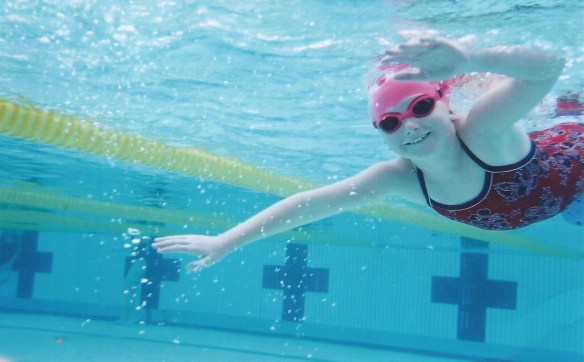
Once we settled on one sport, things began to go swimmingly.

What is your rule for your kids and activities? Do you make them stick with it through the season? Did your parents have a “never quit” rule?

What NOT to do as a sports parent

kat underIn a website called sheknows writer Marshall Bright has some tips for sports parents in Is Your Kid Starting a Sport? Here’s What NOT to Do:

Back-to-school season is also back-to-sports season. While there are summer leagues, many sports time their season to the school calendar. By entering a new grade, many kids may also qualify for a local league or sports team. But before you sign on the dotted line for another season of soccer or basketball, there’s one thing you should do first: Make sure your kid actually wants to participate.

This may seem obvious, but many parents want their children to (or assume their children will) participate in the same sports they loved as kids themselves. And parents of older kids may also just assume their child will stick with whatever sport they’ve already been playing — especially if they’ve been successful in it for a few years. Hopes of seeing your child play varsity, or at the college level, or even just sharing in a sport they love, can cloud what parents should really be focusing on: where your child will have the most fun.

Matt Thompson, the Branch Executive Director of the Gateway Region YMCA, has worked extensively with youth sports during his career with the organization. He has seen firsthand the benefits of sports, which include statistics that show active kids can score up to 40% higher on tests and are 15% more likely to go to college. He also sees statistics on how likely kids are to drop out of sports: most will quit by age 11.

“What’s most important to the kids is having fun,” he says. That means finding sports your kids will actually enjoy.

“One of the things parents tend to lean towards is looking at traditional sports like basketball, baseball, football, and soccer. A lot of our kids these days are very interested in other activities,” Thompson continues. He includes individual sports like swimming, martial arts, and gymnastics, as well as other physical activities like dance that might interest kids. If you allow your children to find activities that they enjoy, they’ll be less likely to drop out later.

If your child isn’t sure what they’ll like, see if there are ways you can explore different options together. Martial arts studios may offer a drop-in class before commitment, for example. That also may mean trying out a few sports for one season until you find the fit. If a child has been an enthusiastic soccer player for several seasons, it also may mean having an ongoing conversation if they’re feeling lukewarm about it suddenly. By making it an ongoing conversation, rather than letting them quit (or insisting they keep playing), you can hopefully support them in finding a better fit, rediscovering their original passion, or even deciding together that it’s time for a break.

16252474_10212368448990127_286308515515991930_o

Early days at the pool.

I think this is good advice to make sure your kids are interested in the activity first — before making a huge commitment. I put my daughter in activities she despised — ballet and piano — and it of course didn’t work out! One day, the ballet teacher pulled me aside after several months and said, “I know she can do it, but she won’t. She just stands there and doesn’t move.”

I loved ballet and I was so surprised that my daughter didn’t love it too! In fact, as an adult, I took up ballet again taking four classes a week and even did a few shows. Our children are different human beings than us and will have their own interests. Give them a chance to try different things and perhaps a passion will take hold.

Our kids ended up in swimming after trying different activities. It was nice they both settled on swimming and we went full bore as a swim family. My son also liked his piano lessons and formed a band plus took lessons until he graduated from high school. He liked music more than swimming the last year or two and we didn’t see it. Or, he didn’t want to disappoint us because we were so invested in the aquatic life. I’d sign him up for swim meets and he’d be a no show because he had other activities going on. It should have been an obvious tell to me when he continually missed practice. We probably could have saved a lot of aggravation and money — if only we’d be honest with each other — or open to a talk that his interests had changed from second grade to a senior in high school!

10272731_10204106235519954_4758912213526292801_o

She didn’t want to be a ballerina. She wanted to swim!

What advice do you have for new sports parents?


When should parents not say a word?


IMG_8584

My daughter swimming on her own during vacation.

I read a great article, “The first rule of sports (and all) parenting: Don’t speak,” in the Washington Post by Nancy Star:

Your child doesn’t have to play in the Super Bowl for you to know the feeling. Their team was supposed to win and then they didn’t. What do you do? Being the mother of two girls who played soccer and ran track, I thought I knew the answer: Talk it through. Tell them you love them. Say it’s just a game. Remind them there’s always a next time. Isn’t that what good parenting is all about? Keeping channels of communication open even in tough moments?

Turns out the answer is no. I learned this when I had a “don’t speak” moment.

I understand this all too well. After my kids would have a disappointing swim, I’d try to reassure them. I wanted to take away their hurt and make them feel better. Most often after I’d say, “That wasn’t so bad,” or “You have another swim ahead,” I’d be met with negativity and a statement like “I sucked!”

I’d get a barrage of negativity that would take me by surprise. I never figured out that by trying to protect them from their upset feelings, I wasn’t making it better for my kids, but was making them feel worse. They weren’t ready to talk about a bad swim with me and “hash and rehash,” as my daughter would say. I read in a David Benzel sports parenting book, “From Chump to Champ,” that we should wait for our kids to talk to us. We need to be there and listen. But, if we start the conversation first, even with the best intentions, they’ll probably pull away and stay quiet. They want to please us so much and may take any little thing we say personally, as though they’ve let us down. It’s best to be quiet and listen. They may surprise us and open up more than ever if we let them take the lead.

Here’s more from the Washington Post article with the mom watching her daughter’s varsity soccer team lose their final meet. She received advice from a dad, Peter, who had more experience with soccer parenting and she followed it.

“Their lead slipped to a tie toward the end of the second half. In the last minute of play there was a stumble, scrambling and a goal for the other team.

Parents supplied transportation for home games, so we waited while our daughters gave sullen high-fives to the winners and then huddled with their coach, listening as he shared his disappointment. When he was done they separated and, backpacks slung over shoulders, trudged across the field toward where we stood.

Watching their grim faces approach I wished a meteorologist were present to confirm my suspicion that 22 high school girls who’ve just lost a chance at a state title can change the atmosphere, collectively sucking the light out of the sky. Their fury was frightening.

But Peter had been through this before. “Don’t speak,” he said. As I started to turn my head he added, “Don’t look. Just walk. Go to your car. She’ll find you.”

I tried not to move my lips as I objected. “All I want to say is I’m sorry.”

“Don’t,” he advised. “Don’t speak. Not until she talks to you.”

Because he had been through this before, I listened and walked to my car alone. I felt her before I saw her, walking silently beside me. Reassuring phrases immediately formed in my brain but, channeling Peter, I said nothing.

A moment later I noticed her teammates walking with their parents, mothers mostly, who offered words of consolation. “Are you okay?” and “You played well,” and “There’s always next time.” To me the words sounded gentle and kind.

The girls did not agree. “No,” they snapped, and “I sucked,” and “There won’t be a next time.”

By the time we reached the car, every daughter except mine was crying and the moms were, understandably, annoyed and lashing back. “Why are you yelling at me?” and “Being upset is no excuse for being rude.”

We were silent on the ride home, silent as I turned on to our street. It was when I pulled into the driveway that my daughter finally spoke. “That was such a bad game.”

I nodded.”

How do you handle your children’s athletic or academic disappointment?

12768251_10209127311323711_1087820356060339429_o

Cheering on a teammate at the PAC 12 Champs.


An Open Thank You to Coaches

kat ann

My daughter with one of her coaches.

I wholeheartedly agree with “An Open Letter to All the Coaches Who Get Yelled At: I Want to Say Thank You” in Popsugar by Angela Anagnost-Repke. My kids have had all sorts of coaches throughout the years. I counted 14 in their age group swimming years alone. Mostly because they started really young and got new coaches as they grew older. Also the assistant coach job is one that turns over frequently. It’s low pay and and not many hours. Then when a long-time head coach switched careers and it took our team a few tries to get a coach who stayed.

From all the coaches my kids had, not one of them was perfect. But my children looked up to them and learned from each and every one. Some were better with parents than others. Some were better at technique or training. Some were better at team spirit and team administration. But all had something valuable to offer my kids. And like the open letter says, they played an important part of my children’s development.

Here’s an excerpt of the open thank you to coaches:

Dear Coaches,

Sometimes you get a bad rap. Parents will say you didn’t play the right kid at the right time. Or that you let little Johnny sit the bench for too long. Maybe you don’t push them hard enough . . . or you push them too hard. On and on. The complaints about coaches seem endless. But I want you to know that there are plenty of parents out there who are truly thankful for the dedication and time that you put into our children — because it not only affects them on the field, but is carried off of the field, too.

As a parent, I’ve sat on the sidelines and watched my children play football, basketball, swimming, and gymnastics. Sometimes they excel naturally at a particular sport, sometimes they don’t. Sometimes they have a great game, and sometimes they play downright bad. I know that’s part of the cycle. And while I provide constant encouragement, it doesn’t mean as much as the encouragement that comes from you, their coach. I truly believe that you coaches ignite a true love of the game (whatever that game may be) within our children.

And I’ve seen it firsthand. My son recently started playing travel football, and thanks to his coaches, he’s improved tremendously. He went from being a kid who haphazardly toe-kicked the ball, to one who willingly goes out in the backyard to practice his new moves. He sets up his little orange cones and encourages his friends to join along in a spontaneous pickup game. And that’s all because of you. His coaches have not only helped him improve, but instilled in him the intrinsic motivation to succeed. And most importantly, they’ve done it at an age-appropriate level, allowing him to fall in love with the game of football — instead feeling pressure to succeed.

I don’t think many parents realise how difficult coaching a sport can be. As a former coach myself, of both high school players and little kids, I know that it is one of the toughest jobs out there. And many of the coaches of little kids are unpaid. They volunteer their Saturday mornings, weekday evenings, and more — all for our children. I think it’s time we gave you the credit you’re due. Because its coaches like you who are doing their best for our kids. You organise the practices, the very important snack schedule, and drills. You encourage our kids, teach them the rules, and help them learn to love exercise.

You also do something very important for our young children — you get them excited about sports. Athletics have come a long way, and it feels like today’s kids can face a lot of pressure about excelling at a sport. But it’s you who takes the time to show them how much fun being on a team can be. You teach them that the real joy from sports comes intrinsically, from the love of the game, not through reward or punishment.

18920513_10213697294250428_7072346138704993087_n

My daughter with her college distance coach watching a teammate’s race.

I think the role and influence a coach has on our children is immeasurable. I will admit that we weren’t always the best parents to have on a team, but we did learn as the years progressed. We wanted our children to be successful and happy. We wanted them to love their sport. With the exception of one or two coaches, our children’s coaches wanted the same things. They were invested in our kids and truly cared.

What are some of the traits you admire most about your children’s coaches?

How to Keep Your Kids in the Game

34614_1556248309940_4797539_nIt’s a hard lesson for sports parents to learn, because we do get all excited watching our kids, but we can put too much performance pressure on them. When we do this, they may lose some of their passion for their sport, play half-heartedly, or quit.

When my son was young, I learned that he listened to his own drummer. Tee ball practices were spent building dirt castles. When I put him on a summer league swim team, I was surprised to see him and a friend out of the pool, sword fighting with sticks. As he got older and focused on swimming, he was hard enough on himself. I didn’t need to add any pressure. He said he still has nightmares about me forcing him to go to a meet that he wasn’t prepared for. I thought meets were fun–at least they were for me. I didn’t see an issue with signing him up for a meet after he had spent the last two months in a school play with little or no practice.

I believe we have to keep in mind our children’s competitive natures and their passion. They have to like their sport. It can’t be done to please us. It’s their sport, not ours. According to a recent poll, 70 percent of kids in the United States stop playing organized sports by the age of 13 because “it’s just not fun anymore.”

Here’s an interesting article in PopsugarUK.com from a mom who wants her kids to enjoy their sports, but is afraid of the culture. Written by Angela Anagnost-Repke, she points out some of the great things about youth sports, as well as the problems. Unfortunately, a few overzealous parents can ruin the sports experience for everyone.

Here’s an excerpt of “I Want My Kids to Play Sports, but Worry How the Culture Will Affect Them:”

I signed my kids up for team sports because playing sports teaches kids more lessons than I can count: how to set a goal and work to achieve it, how to function as part of a team, and how to find that grit we all have deep within us. It also demonstrates that when you’re working with others, on anything, those same people will depend on you. So, it’s on you to bring it every single day — to training, to practice, and to games. I personally have many fond memories of playing football with my teammates, and I want that for my kids, too. But the culture has shifted dramatically since my days on the field, so I’m a little nervous about the whole thing.

I find the pressure to be “the best” in their specialised sport — which I also think kids are forced into choosing far too young — is too intense for kids today. It feels like kids are expected to be a standout athlete before they reach 10 years old. They’re expected to get outside and practice instead of running through the sprinklers with the neighbours, give up going to birthday parties to play in weekend-long tournaments. And the older these children get, the more burned out they become. I’ve seen kids get so worn down from trying to be “the best” that they stop playing sports all together. While they loved it once, that love has diminished, or died altogether, and they can’t bear to play any longer. And, this societal pressure is not the only kind of pressure I see young athletes facing, either.

Today, I also think kids involved in sports receive too much pressure from their parents. As I stand on the sidelines to watch my son play on his travel football team, I hear parents yell at their 6- and 7-year-old boys constantly. “Get up!” “Get your head in the game!” and “You better start trying!” The little boys stiffen up as their parents scream at them and then try just a little bit harder. I can’t help but think that these parents should be yelling praise and encouragement. This pressure carries through to when these kids become young adults. It wears them down. As a high school teacher, I’ve seen it far too many times. These young adults are so burnt out from trying to please everyone around them. They’re crumbling, and it’s a damn shame.

We can cheer and love the life lessons our kids get from their sports. But, we need to keep the pressure to perform in check. If they are having fun, they will stick with their sports.

robkatwaterHow do you help your kids in sports without taking over or adding too much pressure?

How much is too much for youth sports?

kat group

My daughter with her Piranha crew.

Youth sports is a multi-billion dollar industry and as a sports mom myself, I know we were big contributors to it. In an article on CNBC.com, Lorie Konish writes that 27 percent of parents spend $500 or more a month on their children’s sports. That seems crazy high, right? But, especially if you have more than one child, it’s not hard at all to spend that much on sports. Trust me, I know.

As parents of two swimmers we easily did that, especially as the kids got older. We traveled to meets, stayed in hotels and ate out. Then we had the plan to buy an RV to eliminate the hotel stays. There’s some rocket science for you. Do you have any idea what it costs to own an RV? Yep. Pretty much a lot more than a few nights in a hotel per month.

Besides the travel, there were monthly dues for the club team which go up as your children get faster. Private lessons at $50 to $80 an hour to ensure your kids DO get faster. Then, the $485 “fast suit” to super make sure your kids are fast.

Here’s an excerpt from the article and some ideas to ensure you don’t go broke before your kids become super stars making beaucoup bucks–and you can afford your own retirement in case that plan doesn’t pan out–or you don’t win the lottery:

“Your child’s sports could be sabotaging your financial health” 

Parents are spending more than ever on their children’s sports with the hopes that they will make it to the big leagues.

And dads are often the ones likely to shell out the most cash on their children’s activities, according to a new survey from TD Ameritrade.

Yet spending more with the hope that your child will make it big could have consequences for your finances, particularly your own retirement.

The survey, which was conducted online between February and March, included 1,001 adults ages 30 through 60. Of those respondents, those who were considered “sports parents” had one or more children in elite or club competitive sports and had more than $25,000 in investable assets.

The result: 27% of parents spend $500 or more per month on youth sports.

This was especially true for fathers, 20% of whom spend $500 to $999 each month per child on youth sports. Meanwhile, 7% of dads admitted they spend $1,000 or more.

That money is going towards everything from equipment to private coaching to tournaments out of town, according to Dara Luber, senior manager of retirement at TD Ameritrade.

Those dads may be reliving their youth or reviving their own professional sports aspirations, Luber said.

But the one thing those fathers — and all parents — need to be wary of is whether those costs will force them to make sacrifices in other important areas.

For the parents surveyed, that could mean cutting back on spending on entertainment or vacations. It could also mean taking on a second job or delaying retirement.

One in 5 dads surveyed said they worry about how their spending on their children’s sports will impact their retirement savings.

TD Ameritrade also found that sports parents are less likely to save for retirement through a 401(k) plan or individual retirement account than they were three years ago.

“There is nothing wrong with helping your son or daughter realize their sports dreams, but it definitely shouldn’t come at the expense of your own retirement or understate your family’s needs,” Luber said.


34614_1556248309940_4797539_n

My son in front with his Piranha buddies.

Reflections from a new sports parent

robert 1

My son during the age of tee-ball.

Reading an article in the Wall Street Journal called “A Rookie Sports Parent’s Guide to Sports Parenting” by Jason Gay, brought back fond and crazy memories from years ago. When we were first sports parents, our son tried tee-ball. We had some hilarious moments of funny things the kids did, but also not so funny ways that parents acted–including ourselves.

My son never seemed to get into the game. But he loved sitting in the dirt building castles and daydreaming, without noticing or caring that a ball flew or rolled past him. Once, an athletic youngster hit the ball and charged straight out to the field getting to his ball before anyone else could to bring it back. All the parents laughed at that.

It was all going okay, since we didn’t mind our son’s fascination with anything in the field except the ball, until the day one of the coach dads asked my husband to help out. I knew it wasn’t a good idea. My husband is the type of overly enthusiastic guy who can go overboard easily. So when my son was laying in the dirt as short stop, crafting a castle from the red clay and a ball was headed his way, my husband grabbed our son by the back of the shirt, pick him up, and the two raced after the ball together! That was one of the not so good memories. After that day, my husband at least had enough sense to be embarrassed and refused to help out as a tee-ball coach ever again.

We made it through the first season of tee-ball and the season ended with a pool party at our house, complete with the required trophies for everyone–including our son the dirt castle builder. One good thing we did for him–we never signed him up for a season of tee-ball again. We recognized it wasn’t his thing.

Here’s an excerpt from the Wall Street Journal:

“A columnist enters the magical world of practices, game days, and cheese sticks. So far, so good—but it’s early…”

I’ve recently become a bona fide sports parent. I think it’s going fine. I’ve yet to get arrested for sumo-wrestling another parent in the parking lot. Of course, there’s plenty of season left, so who knows.

Here’s what I’ve learned so far:

• The college scholarship offers…I don’t know what your experience was, but I’ll be honest: They haven’t exactly come rushing in. My son is two games into his spring season, and we haven’t had a single nibble from a college coach.

• I should mention my son is 6 years old, and he just started playing Pee Wee baseball. But still, college coaches: Make us an offer! Even a half scholarship will do. Wisconsin: Where are you?

• I’m giving my son two more weeks to get a scholarship offer before I start photoshopping his head atop the bodies of high-school rowers. Is this illegal? Please let me know.

• Ah that’s right: Wisconsin hasn’t had a baseball team for ages. This seems bizarre. The Badgers have a varsity bratwurst team.

• The parents around my son’s team are kind, encouraging and seem uninterested in being bad sports parents—you know, the sports parents that end up on the 11 p.m. local news, swinging folding chairs at each other. To be sure, it’s easier being a good sports parent when it’s just 6-year-olds. I’m sure the sports parenting gets a lot more intense when the games mean something, and the kids are older, like 7.

• So far, we’re staying local. This keeps it sane. Every sports parent I know with older sports children says the happiest days of their lives are when their children are born—and the saddest days are when their children make travel teams.

• It’s kids—not adults—who have the correct perspective on sports. My son likes playing baseball, but if, on the way to the game, I told him we were going to skip baseball and go look for hermit crabs, he’d be perfectly fine with that, too.

• Last week my son asked me: “Do we have that thing on Saturday…What’s that thing I play?” It was adorable, and yet I also thought: Here’s a golden opportunity to prank him into thinking he’s on a badminton team.

There is a lot more good stuff in Jason Gay’s article. I suggest you click on the link above and read it. Having been through the years of sports parenting and being a sports parenting writer — I’m kind of jealous. He’s got all these years ahead of him to enjoy.

kat and rob beach

The best of times were letting the kids play for hours on end at the beach.

What are some of the funny or crazy moments you remember as a sports parent — or that your parents did?