5 Tips for Parents of Graduating Seniors

Here’s a story I wrote a few months before I officially became an “empty nester.” Many of my friends are going through the transition from full-time parents with their kids graduating high school and starting the next phase of their lives. This story is for anyone facing the empty nest or having their oldest child graduating high school. Trust me, it gets better and you’ll learn to love some “me” time.

I’ve written about the top 10 things kids need to know before leaving for college. But, what about us? When our kids leave, it’s a drastic change in our lives.

IMG_1743

When we took our son, our oldest child, to University of California Santa Barbara, I was strong. I was emotional about moving him into the dorms, but I was excited for him, too. I loved college. They were some of the best years. I was excited for him to love it, too.

But, then we said our good-byes. It hit. Like a punch in the stomach. Then, the tears. Oh, my! I wasn’t expecting that. The drive home, my younger child, age 15, looked at me in horror. I was falling apart. Thank goodness for her riding in the car with me. I probably would have wailed like a complete idiot without her staring at me.


IMG_1721

My son on our friend’s sailboat during orientation weekend.

Now, I have a few months left before I face a totally empty nest. What did I learn the first time around to prepare me for this time?  I wish I knew some secret to make it easier.

During orientation, UCSB gave parents a few tips on how to parent your college kid. This is what I remember:

1. Give them space. Don’t hover, don’t call too often, never call before 10 a.m.

2. Set up a time to make calls on a weekly basis — and not more often than that.

3. Expect them to get homesick. It’s natural they will miss home-cooked meals, their own room, their friends, pets, and you!  Reassure them that this is normal. They tend to get homesick around six to eight weeks. It will get better. They’ll adjust. But, will you?

4. Be sure to send a few care packages. Their favorite cookies, toiletries, something to make them smile. Mid-terms and finals weeks are ideal times to mail care packages.

5. Take time for yourself! Write, paint, sew, take a yoga class. Do something every week for just you. Make a list of things you used to love doing, but through the child-raising and working years, haven’t found time to do. Make another list of things you’ve always wanted to do, but haven’t. You’ll find your way.

IMG_2265

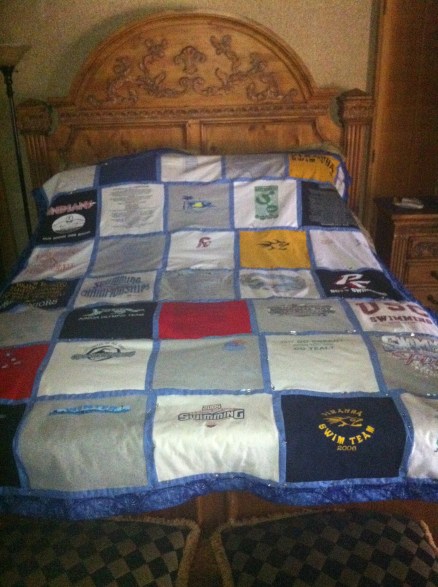
The quilt I made my son out of his swim tee shirts.

IMG_2339

My kids not wanting me to take their pic on the UCSB campus.


Do Latchkey Kids Become Helicopter Moms?


IMG_8366

The park where my kids grew up playing outdoors.


I find the headlines of parenting articles to be pretty funny these days. I’ve heard about helicopter parents who hover endlessly over their kids and interfere at the workplace and summer camp. But, I’ve never heard about lawnmower parents before. Have you?

When I was growing up, a lot of kids went home after school to empty houses. More women were working, plus there were a lot more single-parent homes than in previous decades. There was a popular phrase back then called “latch-key kids.”

Here’s a memory about how different parenting was back when I was a kid compared to today. When I was in high school, I took a road trip with one of my best friends from our hometown Snohomish to Sun Valley, Idaho. My friend’s parents asked us to drive their pickup truck while they flew–a 675-mile trip! We slept in the back of the pickup truck in sleeping bags somewhere in Oregon. Then once we got to Sun Valley, we had planned to pitch a tent in a local campground, because we weren’t invited to stay in the Sun Valley lodge with my friend’s parents. For some reason, we chose to sleep in the parking lot in the back of the truck instead. I remember one night the parents were out late in the pick-up truck and we were sitting on the curb in the parking lot, waiting for them to return and to crawl into our sleeping bags. We were on our own for meals and everything. Wow. Talk about NOT being a helicopter parent!

In “Finding a balance between latch-key and helicopter parenting,” I found some interesting ideas:

“Latch-key kids surged from the 1970s to the early 1990s due to economic changes requiring two incomes to get by, and societal changes where an increased divorce rate created single-parent homes.

‘Now the generation of latch-key kids are parents themselves. Many generation X’ers over-compensate for their latch-key upbringing by being a helicopter parent,’ Janice Emery, 4-H youth development specialist with the University of Missouri Extension, said.

A helicopter parent is a parent who pays extremely close attention to their child’s experiences and problems. Helicopter parents are so named because, like helicopters, they hover overhead.

As parents, it is important to find the middle ground between these parenting styles and balance protecting children, and making sure they grow into responsible adults,” Emery said. “Parents have to keep in mind parenting success is not measured by how much a parent does for their child, but rather how much they teach them to do on their own.”

The second article I read today explains the difference between helicopter and lawnmower parents. In my humble opinion, I don’t see that much difference between the two of them. Both won’t allow their kids to fail and learn from their mistakes. I do agree we need to do less for our kids so they can grow up to be competent, well-balanced adults.

Helicopter of Lawnmower? Modern Parenting Styles Can Get in the Way of Raising Well-Balanced Children

“Helicopter parents, as the name suggests, spend a lot of time hovering. They always stay close to their children, ready to swoop in and direct, help or protect (usually before it is needed). Lawnmower parents are one step ahead of their children, smoothing their path and making sure nothing gets in their way. Common tactics of both include interfering significantly with their grown-up children’s lives, such as complaining to employers when their children don’t get a job.

As with anything, there is a middle ground. It doesn’t take a rocket scientist to realise that providing children with opportunities and support helps them to gain experiences, confidence and networks that they wouldn’t be offered in more adverse settings. But there is an important line between supporting children and wrapping them in gold-plated cotton wool.

Allowing children freedom to take appropriate risks through outdoor play is essential for their development. Risky play does not mean placing children in grave danger, but instead allowing them to be children – climbing, jumping from heights and hanging upside down are good examples. Risky play allows children to test limits and solve problems. And, yes, this includes learning what happens when they overstretch themselves and fall.”


1_498389_0_1370586658_636x435

A view from my home town where I was a latch-key kid.

When I was growing up, we could ride bikes throughout the countryside. We told our parents where we were going—it could be to a friend’s house who lived five miles away—and our parents never worried. Even our golden retriever Pepi lived a free-range life.

For some of my childhood, I was a latch-key kid and the scary thing about it was going home to an empty house. If my brother, who was two years older, had golf or tennis practice, then I was riding the school bus alone and being dropped off at a bus stop, a quarter mile from my house. It was lonely and quiet, but I survived. The bad days were when Thelma, our bus driver, dropped me off at my doorstep and announced that a prisoner had escaped from the Monroe Penitentiary, which was a couple miles away. She’d wait until I was safely inside my empty house. Those were the worst days as a latch-key kid.

I wonder if spending some years as a latch-key kid influenced my involvement with my children every step of their way to becoming adults?

16387049_10155016389924612_4962935708272400344_n

The pool and swim team that allowed my kids space in a safe environment without me helicoptering–too much.

Did you grow up as a latch-key kid and do you think it affects how you parent? Or do you think we’re living in different times and we cannot allow our kids the same amount of freedom we had?

How much is too much for youth sports?

kat group

My daughter with her Piranha crew.

Youth sports is a multi-billion dollar industry and as a sports mom myself, I know we were big contributors to it. In an article on CNBC.com, Lorie Konish writes that 27 percent of parents spend $500 or more a month on their children’s sports. That seems crazy high, right? But, especially if you have more than one child, it’s not hard at all to spend that much on sports. Trust me, I know.

As parents of two swimmers we easily did that, especially as the kids got older. We traveled to meets, stayed in hotels and ate out. Then we had the plan to buy an RV to eliminate the hotel stays. There’s some rocket science for you. Do you have any idea what it costs to own an RV? Yep. Pretty much a lot more than a few nights in a hotel per month.

Besides the travel, there were monthly dues for the club team which go up as your children get faster. Private lessons at $50 to $80 an hour to ensure your kids DO get faster. Then, the $485 “fast suit” to super make sure your kids are fast.

Here’s an excerpt from the article and some ideas to ensure you don’t go broke before your kids become super stars making beaucoup bucks–and you can afford your own retirement in case that plan doesn’t pan out–or you don’t win the lottery:

“Your child’s sports could be sabotaging your financial health” 

Parents are spending more than ever on their children’s sports with the hopes that they will make it to the big leagues.

And dads are often the ones likely to shell out the most cash on their children’s activities, according to a new survey from TD Ameritrade.

Yet spending more with the hope that your child will make it big could have consequences for your finances, particularly your own retirement.

The survey, which was conducted online between February and March, included 1,001 adults ages 30 through 60. Of those respondents, those who were considered “sports parents” had one or more children in elite or club competitive sports and had more than $25,000 in investable assets.

The result: 27% of parents spend $500 or more per month on youth sports.

This was especially true for fathers, 20% of whom spend $500 to $999 each month per child on youth sports. Meanwhile, 7% of dads admitted they spend $1,000 or more.

That money is going towards everything from equipment to private coaching to tournaments out of town, according to Dara Luber, senior manager of retirement at TD Ameritrade.

Those dads may be reliving their youth or reviving their own professional sports aspirations, Luber said.

But the one thing those fathers — and all parents — need to be wary of is whether those costs will force them to make sacrifices in other important areas.

For the parents surveyed, that could mean cutting back on spending on entertainment or vacations. It could also mean taking on a second job or delaying retirement.

One in 5 dads surveyed said they worry about how their spending on their children’s sports will impact their retirement savings.

TD Ameritrade also found that sports parents are less likely to save for retirement through a 401(k) plan or individual retirement account than they were three years ago.

“There is nothing wrong with helping your son or daughter realize their sports dreams, but it definitely shouldn’t come at the expense of your own retirement or understate your family’s needs,” Luber said.


34614_1556248309940_4797539_n

My son in front with his Piranha buddies.

Changes on the home front

59756764_10219573479551388_7700711190170697728_nI am excited with the changes to our home–and feeling nostalgic. This past week, we had painters in to update the kids rooms from the way they’ve been for the past 15 or so years. Our son’s room was a bright white to begin with. I had my daughter’s room painted pale pink before she was born. Then as they neared the teen years, the colors got bright.

My son’s room turned into what’s known as a Delaware blue complete with a world map on one wall. My daughter went hot pink. That didn’t last long. She eventually went with two shades of teal, her favorite color.

59418919_10219566377893851_6780426138180124672_nWhat stayed constant was the deep blue tiki bathroom. When we moved into our house 25 plus years ago, I loved the tiki bathroom. I still do actually, but it was looking more than a little ragged. For example, some of our recent horrific rains came through the ceiling vent and stained the ceiling. We had quite a discussion of what to do with the bathroom.

My son said I could throw out whatever I wanted in his room. I saved a few things, but the majority of books, DVDs, CDs, school work, trophies, etc. went to Angel View, our local charity where you can dump–I mean donate–all your unwanted junk. My daughter wants to go through her things before we toss. She hasn’t been out of the home technically for a year yet, so I guess I owe her that. But I’m on a roll. It feels really good to lighten our load of knick knacks, stacks of books, DVDs, electronics and extra furniture. I like the new look of off-white bedrooms and a pale blue bathroom.

It also feels sad. I miss all those years when I had bedrooms with wild colors and my children.

59295725_10219573478871371_3429239706036994048_n.

What happened to May Day celebrations?

images-5

In first grade, my teacher Mrs. Iverson showed us how to make May Day baskets from pink and yellow construction paper. We drew ivy and flowers on the paper baskets with our thick crayons before going up one-by-one to our teacher to get the handle stapled on.

On the way home from school, we walked together picking dandelions and soft lavender-colored clover to fill our baskets.

images-6We took turns “May Daying” the neighbors.

I climbed the steps to Mrs. Fixie’s front door. She was the grandmotherly lady with the neat white bun on top of her head who often gave me home-made oatmeal cookies.

I hung the basket on her doorknob. Then, I rang her doorbell and ran as far as my first-grade legs would take me. I hid behind a hedge and watched her open the front door and scan the neighborhood.

images-9Then, she looked at her doorknob at the paper basket filled with flowering weeds.  A big smile broke across her face.

“Happy May Day!” I yelled jumping up behind the shrubs.

search

Where did this fun tradition begin? But, more importantly, where did it go?

Do your kids make May Day baskets in school? Do they surprise your elderly neighbors with baskets of flowers and sunshine on May 1st?images-8

My mom is in an assisted living home two states away. She’ll be getting a delivery from FTD today of a little basket of flowers. The card will read “Happy May Day! Love, ?”

She’ll call and thank me and I’ll say, “I don’t have any idea what you’re talking about!”

She’ll say, “Really? I could have sworn it was you! I wonder who sent me these flowers?”images-7

That’s how we keep our May Day tradition alive. My son sent me a text to wish me “Happy May Day” first thing this morning. My daughter may pick some snap dragons and roses from our back yard and pound on the door tonight after school and her swim meet.

I’ll run outside and won’t be able to contain the smile on my face as I race around the yard trying to catch her.

images-3

Happy May Day, everyone! How do you celebrate May Day? Do your kids make baskets?

imgres-2